Home › Services › Burst Pipe Repair
Plumbing · Harrisburg, PABurst Pipe Repair in Harrisburg, PA
A burst pipe is the most destructive plumbing failure a Harrisburg home can suffer, and it is also one of the most common. Burst pipe repair in Harrisburg, PA is the emergency service that stops the water, repairs the split pipe, and protects the run so the next freeze does not do the same thing in the same place. This page explains why Harrisburg pipes burst, what to do in the first minutes, and how the repair is done.
Talk with a local plumbing professional
Hours: Mon–Fri 7:00 AM–10:00 PM ET · Sat 8:00 AM–10:00 PM ET · Sun 7:00 AM–9:00 PM ET
Call NowWhat is burst pipe repair?
A burst pipe is a supply pipe that has split open, usually because the water inside it froze and expanded, or because corrosion thinned the wall until the pressure found the weak point. The split is most often a lengthwise crack in the pipe wall, and it opens under normal water pressure the moment the ice thaws or the weakened wall gives way. The water that escapes runs until the main is shut off, and it runs into the structure — inside walls, above ceilings, under floors.
Repair means replacing the damaged section of pipe, not patching it. The split section is cut out, the pipe is replaced with the right material for the existing system, and the joints are made properly. A patch or a clamp can stop the leak for a day, but a frozen pipe that has split once has been stressed along its length, and the repair should cover the damaged section rather than the visible crack alone.
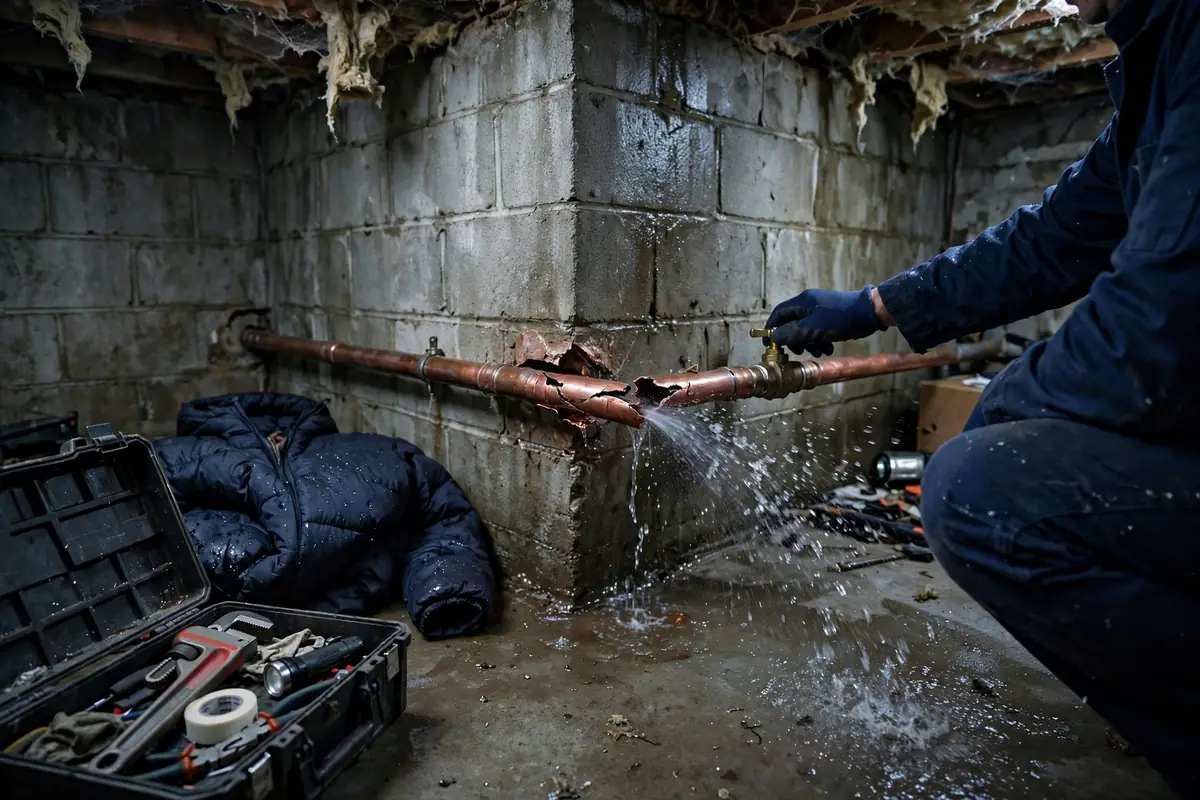
The numbers behind the problem are local. Harrisburg sees around 101 nights a year at or below freezing. Water expands by about nine percent when it freezes, and the pressure it creates is enough to split copper, PEX and galvanized steel alike. On January 28, 2025, Harrisburg firefighters answered more than two dozen burst-pipe calls in a single day as temperatures warmed after a freeze — the split pipes had frozen overnight and started leaking as they thawed. The median Harrisburg home was built in 1947, and 43 percent of homes are older than 1940, so the pipes at risk are often galvanized steel that has been corroding from the inside for generations.
A burst pipe is a race against the water. A single split pipe can release hundreds of gallons per hour into walls, ceilings and finished basements, and the damage grows with every minute the main stays open. The first step is always the same: shut off the main, then call.
Call NowSigns you need burst pipe repair
- Water spraying or pouring from a pipe: The obvious sign: water coming from a pipe in the basement, a utility room, or inside a wall. Shut the main off first, then call. The visible water is only part of what is already inside the structure.
- A ceiling stain that is growing: A stain on a ceiling that is wet to the touch and growing by the hour means water is still moving above it. The pipe above the ceiling has failed, and the water is spreading through the drywall.
- No water at a tap after a freeze, then a leak: A tap that gives nothing during a cold snap, then a leak appears as the temperature rises, is the classic freeze-burst sequence. The pipe froze, split, and started leaking when it thawed.
- A drop in water pressure across the house: A sudden drop in pressure at every tap, with no obvious leak, can mean a pipe has burst inside a wall or under a slab. The water is escaping somewhere it cannot be seen.
- A hissing sound inside a wall: A hiss with no visible water often means the break is inside a wall or under a floor. The sound is water spraying inside the structure, and it needs the main shut off before it is investigated.
- A damp patch on a wall or floor with no source: A patch of damp drywall, a buckling floor, or a carpet that is wet with no spill above it means water is coming from inside the structure. The source is usually a pipe in the wall or under the floor.
What causes it
- Freezing in exterior walls: Pipes running through exterior walls with inadequate insulation are the number-one freeze location in Harrisburg homes. A kitchen sink or a bathroom vanity on an outside wall, especially in an addition or a bump-out, is the classic freeze point.
- Freezing in unheated spaces: Crawl spaces, attics, garages and unfinished basements track outdoor temperatures, and any pipe running through them is exposed. Older Harrisburg homes often have pipes routed through these spaces because that was how they were built.
- Freezing in vacant or under-heated homes: A home left at a low thermostat setting, or a vacation property with the heat turned down, freezes quickly. A pipe that froze once will freeze again in the same place unless something changes.
- Corrosion in galvanized steel: Galvanized supply lines corrode from the inside, thinning the wall until the pressure finds the weak point. A line that has been narrowing for years can burst without a freeze, at a threaded joint or a weakened section.
- High water pressure: Municipal pressure that runs high, or a failed pressure-reducing valve, stresses every joint and weak point in the system. The failure appears at the weakest pipe first, and in an old system there is always a weakest pipe.
How the work is done
- Shut off the main: The call starts with the shutoff. In most Harrisburg rowhomes and older borough houses the main valve is in the basement on the front wall, where the water service enters from the street, close to the meter. In a post-war ranch it is more often in a utility room or near the water heater.
- Find the split: The burst is located by tracing the line from the shutoff, checking the meter, and opening the smallest access needed. A burst that is visible in a basement is found quickly; a burst inside a wall takes tracing and a careful opening.
- Cut out the damaged section: The split section is cut out, and the pipe is inspected on either side of the split. A freeze stresses the pipe along its length, so the replacement covers the damaged section rather than just the visible crack.
- Replace with the right material: The new section is matched to the existing system — copper to copper, PEX to PEX, or a proper transition where the material changes. The joints are made to last, not to hold until the next freeze.
- Protect the run and test: The repaired run is insulated where it is exposed, the system is pressurised slowly, and every joint is checked. The rest of the exposed runs in the house are checked too, because a house that froze in one place has the same exposure elsewhere.
What the service includes
- Shutoff guidance on the call so the water stops before anyone arrives
- Burst location and tracing through walls, floors and slabs
- Section replacement in copper, PEX and galvanized systems
- Frozen pipe thawing where the pipe has not yet split
- Insulation of the repaired run and other exposed runs
- Pressure testing of the repair and the surrounding system
- Advice on preventing the next freeze in the same house
- Permit handling for work inside the City of Harrisburg
Your options
Section replacement
The damaged section is cut out and replaced with the right material for the system. This is the standard repair for a single freeze split or a corroded section in an otherwise sound line.
Full run replacement
When the pipe is galvanized and corroded along its length, or when a freeze has stressed a long run, the whole run is replaced rather than one section. The repiping page explains when a full replacement is the honest answer.
Freeze protection
Insulation, heat tape where appropriate, and sealing the air leaks that let cold air reach the pipe. Protection is fitted at the same visit, because a repaired pipe in the same uninsulated wall will freeze again.
Repair or replace?
A single freeze split in a sound copper or PEX line is a repair: cut out the split section, replace it, insulate the run. A burst in a galvanized line that has corroded along its length is a different answer, because the next burst is already forming a few feet down the same line. The age and material of the pipe decide, and the inspection of the pipe on either side of the split is what shows it. A line that has burst twice in different places is a line that needs replacing, not a line that needs a third section repair. The repiping page walks through that decision for a whole house.
Can I do this myself?
The homeowner's job in a burst-pipe emergency is two things: shut off the main, and keep people out of water near electricity. Thawing a frozen pipe is the one step a homeowner can attempt, and it must be done with gentle heat — a hair dryer on low, aimed at the frozen section with the tap open — never with a torch or an open flame, which is how houses catch fire. Even gentle thawing only helps if the pipe has not already split, and a split pipe starts leaking the moment it thaws. The repair itself — cutting out the section, making the joints, pressure-testing the system — is professional work, and inside the City of Harrisburg it needs a permit and a city-registered master plumber.
Plumbing in Harrisburg: the local picture
Harrisburg's burst-pipe pattern is written into its winters and its housing. The city sees around 101 nights a year at or below freezing, and the freeze-thaw cycles mean pipes can sit at the edge of freezing for days before a polar-vortex night pushes them over. The housing stock is old — the median home was built in 1947 — and the pipes at risk are galvanized steel in exterior walls, crawl spaces, garages and attics that were never insulated to modern standards. Midtown and Uptown rowhomes have kitchen and bathroom runs on exterior walls. Allison Hill's steep grades put pipes under extra stress. Shipoke's floodplain history means basements and low pipe runs have been soaked repeatedly.
January 28, 2025 is the date that shows the pattern in one day. After a hard freeze, temperatures warmed, the frozen pipes thawed, and Harrisburg firefighters answered more than two dozen burst-pipe calls. The pipes had split overnight and started leaking as they warmed — which is why a tap that runs dry during a freeze and a leak that appears the next morning are the same event. The suburbs follow the same pattern: Mechanicsburg and Camp Hill ranches with utility-room plumbing, Hershey's older homes, Carlisle's borough houses — all with exterior-wall runs and unheated spaces that freeze on the same nights.
Mistakes to avoid
- Thawing before checking for a split: A frozen pipe that has already split starts leaking the moment it thaws. Look for a split before applying heat, keep the tap open, and shut the main off first if you are unsure.
- Using a torch to thaw a pipe: An open flame or a torch near a frozen pipe is a fire risk, especially in a wall full of dry timber and insulation. Gentle heat from a hair dryer is the safe method, and only when the pipe has not split.
- Waiting for the thaw to see what happens: A split pipe does not announce itself until it thaws, and by then the water is already running. Shutting the main off during the freeze, if a pipe is suspected frozen, stops the leak before it starts.
- Repairing only the visible crack: A freeze stresses the pipe along its length. Replacing only the visible split leaves a weakened section that can fail at the next freeze. The replacement should cover the damaged section.
- Leaving the run uninsulated after repair: A repaired pipe in the same uninsulated wall will freeze again at the next hard freeze. Insulation and air sealing are part of the repair, not an optional extra.
What to have ready before you call
- Know where the main shutoff is before winter — basement front wall near the meter in most city homes
- Keep the heat at a steady temperature during a cold snap, and open cabinet doors under sinks on exterior walls
- Disconnect hoses from outdoor spigots before the first hard freeze
- Note which taps run dry during a freeze and which rooms have exterior-wall plumbing
- If a pipe is suspected frozen, shut the main off before thawing
- Take photos of any water damage for your own records
What shapes the scope of the work
Burst pipe work varies with the location of the split, the access, and the material. A split section of exposed copper in a basement is a different job from a burst inside a finished wall, and a burst under a slab is a different job again. The factors that shape the scope are where the pipe failed, how much wall or floor must be opened to reach it, the age and material of the system, and whether the repair is a section replacement or a full run. Water damage to the structure is a separate matter from the pipe repair, and the two are handled in sequence: stop the water, repair the pipe, then deal with the drying and the structure.
How to choose a provider
Ask how the provider will find the split and how much of the pipe they will replace. A provider who talks about cutting out the damaged section rather than patching the visible crack, who checks the rest of the exposed runs, and who insulates the repaired run is working on the next freeze as well as this one. Ask whether the work needs a permit, since pipe replacement inside the City of Harrisburg does, and ask what the freeze protection covers. The provider who answers those questions is the one whose repair will still be holding when the next cold snap arrives.
Other plumbing services
Questions, answered
What should I do first if a pipe bursts?
Shut off the main water valve first. In most Harrisburg homes it is in the basement on the front wall, near the meter. Then call. Shutting the main stops the damage from growing.
Why do pipes burst when they thaw, not when they freeze?
The pipe splits while the water inside it is frozen and expanding. The leak only shows when the ice thaws and water can flow through the split again. That is why January 28, 2025 produced so many calls as temperatures warmed after a freeze.
Where do Harrisburg pipes freeze most often?
Exterior walls, crawl spaces, attics, garages and unfinished basements — anywhere the pipe is exposed to outdoor temperatures. Kitchen sinks and bathroom vanities on outside walls, especially in additions, are the classic freeze points.
Can a frozen pipe be thawed without bursting?
Yes, if it has not already split. Use gentle heat from a hair dryer on low, with the tap open, and look for a split before you start. Never use a torch or an open flame.
Should I shut off the main if I suspect a frozen pipe?
Yes. If a pipe is suspected frozen, shutting the main off before thawing stops the leak if the pipe has already split. It is the safe step.
Do I need a permit for burst pipe repair in Harrisburg?
Inside the City of Harrisburg, pipe installation or replacement needs a permit and the work must be done by a city-registered master plumber. The emergency work to stop the water is done first; the permit is handled as part of the permanent repair.
Will the same pipe burst again next winter?
It will if nothing changes. A pipe that froze once will freeze again in the same place unless the run is insulated, the air leaks are sealed, or the pipe is rerouted. Freeze protection is part of the repair.
How much water can a burst pipe release?
A single split pipe can release hundreds of gallons per hour into walls, ceilings and finished basements. The damage grows with every minute the main stays open, which is why the shutoff comes first.
Need burst pipe repair? Call Now.
Talk with a local plumbing professional about your home. Hours: Mon–Fri 7:00 AM–10:00 PM ET · Sat 8:00 AM–10:00 PM ET · Sun 7:00 AM–9:00 PM ET.
Call NowGet in touch
Call Now from any page and you will be connected with a local plumbing professional serving Harrisburg and the surrounding metro. You can also reach us by email at hello@harrisburgplumbingpros.com.
Hours: Mon–Fri 7:00 AM–10:00 PM ET · Sat 8:00 AM–10:00 PM ET · Sun 7:00 AM–9:00 PM ET.
Call Now