Home › Services › Tankless Water Heater Installation
Plumbing · Harrisburg, PATankless Water Heater Installation in Harrisburg, PA
A tankless water heater heats water only when a tap opens, and it keeps heating for as long as the tap stays open. There is no tank to fill, no stored water cooling between uses, and no tank wall to corrode through. Tankless water heater installation in Harrisburg, PA is the service that replaces a tank heater — or serves a home that never had one — with a wall-mounted unit sized to the household's actual hot-water demand.
Talk with a local plumbing professional
Hours: Mon–Fri 7:00 AM–10:00 PM ET · Sat 8:00 AM–10:00 PM ET · Sun 7:00 AM–9:00 PM ET
Call NowWhat is tankless water heater installation?
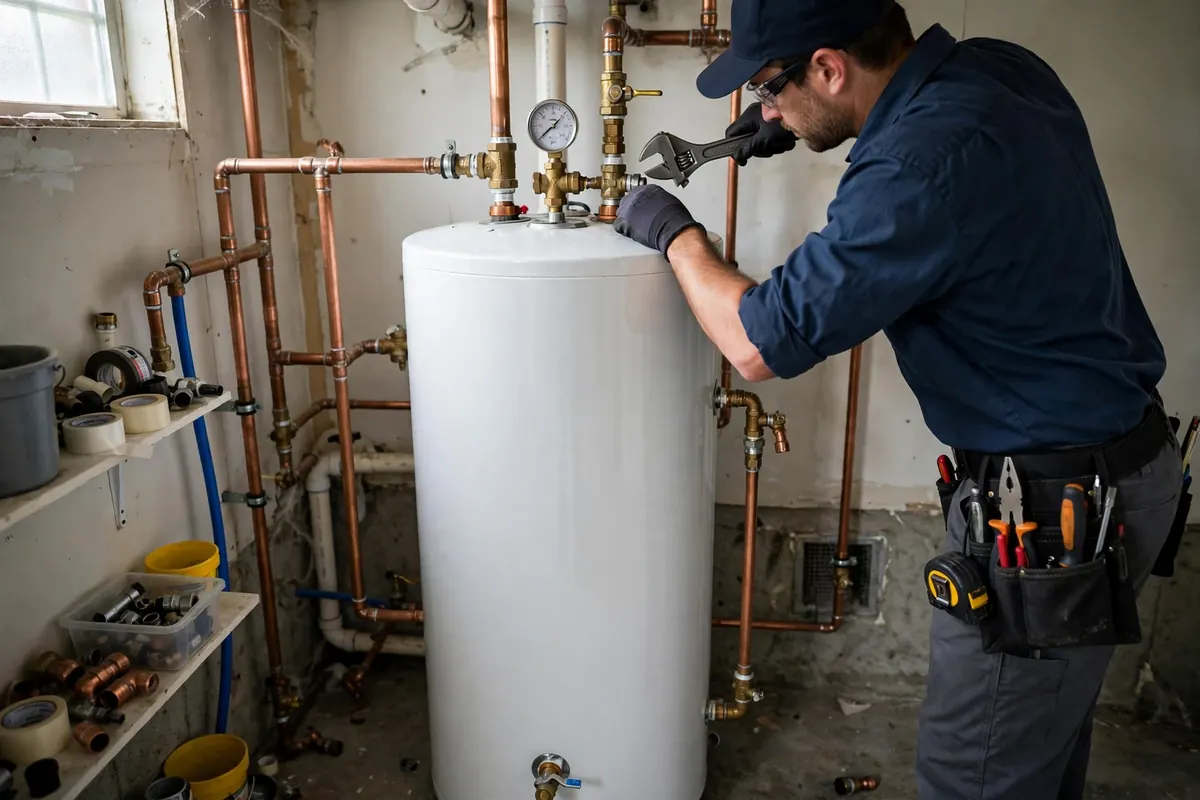
A tankless water heater is a heat exchanger with a burner or electric elements, mounted on a wall. When a hot tap opens, a flow sensor starts the burner or the elements, and water passing through the exchanger is heated on its way to the tap. When the tap closes, the unit shuts down. The water is heated once, at the moment of use, and there is no stored hot water to keep warm.
The difference from a tank heater is not just efficiency; it is failure mode. A tank heater fails by leaking forty or fifty gallons onto the floor. A tankless unit has no stored water, so that failure does not exist. What a tankless unit does have is a flow rate — a maximum amount of hot water it can produce at a given temperature rise — and that flow rate is the whole sizing question. A unit sized for one shower at a time will disappoint a household that runs two showers and a dishwasher together.
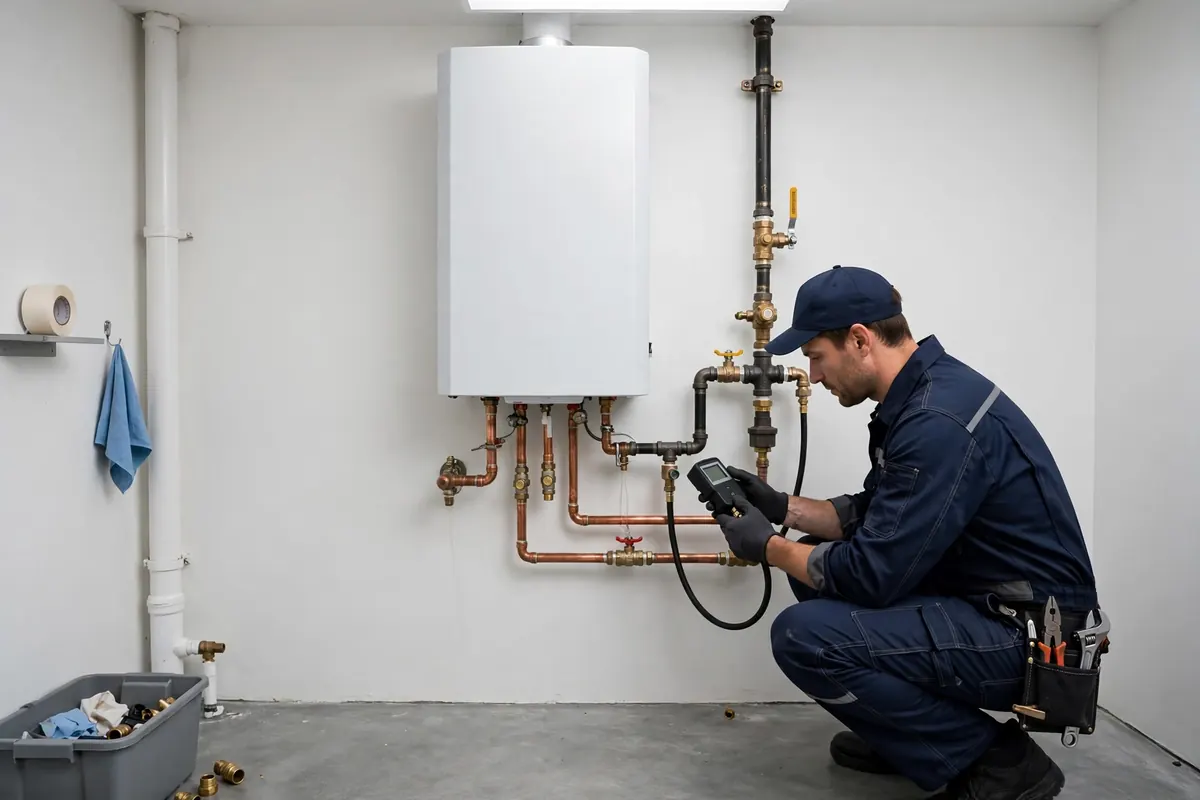
Harrisburg is a natural fit for tankless. The housing stock is old, the basements are often damp, and the tank heater sitting in a Shipoke basement or a Midtown utility room is the appliance most likely to fail by leaking. A tankless unit hangs on the wall, has no stored water to spill, and frees the floor space the tank occupied. It also matches the way larger households actually use hot water: back-to-back showers, laundry and a dishwasher running together, without the third shower going cold.
This page explains how tankless works, what sizing really means, what the installation involves in an older Harrisburg home, and when a tankless unit is the right choice — and when a new tank heater is the honest answer instead.
Call NowSigns you need tankless water heater installation
- Hot water that runs out during back-to-back showers: A household that runs out of hot water when showers follow each other, or when the washer runs during a shower, has outgrown its tank. A tankless unit sized for the household's peak demand removes the limit entirely.
- A tank heater that is leaking or rusting: A tank that is leaking through its wall, or delivering rust-coloured water, is at the end of its life. Replacing it with a tankless unit removes the tank — and the failure mode — from the house.
- No floor space for a tank: A tankless unit hangs on a wall and frees the floor space a tank occupies. In a small utility room, a crowded basement, or a home where the tank sits in the middle of the usable space, that matters.
- A home with high hot-water demand: Large households, homes with soaking tubs, and houses where laundry and showers overlap need a heater sized for peak demand. A tank is sized by gallons stored; a tankless unit is sized by flow, and it can be sized to the household's actual peak.
- A new build or a major remodel: A remodel that moves the kitchen or adds a bathroom is the natural moment to switch to tankless, because the gas line, venting and water lines are being worked on anyway. The installation fits into the remodel rather than disrupting a finished home.
- A tank that keeps needing repairs: A tank heater that has had an element, a thermostat and a relief valve replaced in short order is telling you the tank is at the end of its service life. The next failure is the tank wall, and a tankless replacement answers it before the leak arrives.
What causes it
- Undersized unit: The most common tankless disappointment is a unit sized for one fixture serving a household that uses two or three at once. Sizing is done by flow rate at the winter temperature rise, not by the size of the house, and Harrisburg's cold winter incoming water makes the temperature rise larger than in a warm climate.
- Hard water and scale: Central Pennsylvania water leaves mineral scale, and a tankless heat exchanger is sensitive to it. Scale narrows the exchanger passages, reduces flow, and can trigger error shutdowns. A tankless unit in this region needs regular descaling and, in many homes, water treatment.
- Inadequate gas supply: A gas tankless unit needs a larger gas line than a tank heater, because it burns more gas in a shorter time. An older Harrisburg home with a small gas service may need a gas line upgrade before the unit can run at full capacity.
- Venting requirements: Gas tankless units vent differently from tank heaters — often through the wall with PVC or stainless venting rather than up a chimney. An older home's chimney may not be suitable, and the vent route shapes the installation.
- Cold incoming water: Harrisburg's winter incoming water is cold, which means the unit must raise the temperature further than it would in a warm climate. That larger temperature rise reduces the flow rate the unit can deliver, and the sizing must account for it.
How the work is done
- Measure the household's peak demand: The sizing starts with how the household actually uses hot water: how many showers, whether the washer and dishwasher run at the same time, and whether a soaking tub is in use. The peak demand sets the flow rate the unit must deliver.
- Check the gas, electric and venting: The existing gas line size, the electrical service, and the vent route are checked against what the unit needs. A gas line upgrade or a new vent route is part of the installation plan, not a surprise found halfway through.
- Choose the unit and the location: The unit is chosen by flow rate at the winter temperature rise, and the location is chosen for venting, gas access, freeze protection, and service access. An exterior wall in a heated space is the usual choice in a Harrisburg home.
- Install, vent and connect: The unit is mounted, the gas and water lines are connected, the venting is run, and a condensate drain is fitted where the unit condenses. The work is done to the manufacturer's instructions and to the local code, with a permit where the city requires one.
- Commission and test at peak load: The unit is started, the temperature is set, and the system is tested at the household's peak demand — two showers and a tap running together — so the sizing is proven in use rather than assumed on paper.
What the service includes
- Household hot-water demand assessment and unit sizing
- Gas tankless and electric tankless installation
- Gas line sizing and upgrade where needed
- Venting design and installation
- Condensate drain fitting
- Water treatment and scale-protection advice
- Descaling and maintenance schedule setup
- Removal and disposal of the old tank heater
- Permit handling for work inside the City of Harrisburg
Your options
Gas tankless
The standard choice for a whole-house tankless installation in Harrisburg, because gas delivers the high flow rate a household needs in winter. It needs a gas line sized for the unit and a vent route to the outside.
Electric tankless
A fit for a small household, a point-of-use application, or a home without gas. Whole-house electric tankless needs a large electrical service, and it is sized carefully against the winter temperature rise.
Tankless with recirculation
A recirculation loop keeps hot water at the tap without waiting for the unit to fire and the line to clear. It is the answer for a home with long pipe runs from the heater to the far bathroom.
Repair or replace?
Tankless versus tank is a replacement decision, not a repair decision, and it is made on the household's demand and the home's infrastructure. A tankless unit suits a household that runs out of hot water, a home where the tank has failed, and a house with the gas capacity and vent route to support it. A new tank heater suits a household whose demand is modest, a home where the gas line cannot support a tankless unit without major work, and an owner who wants the simplest replacement. The honest answer comes from the sizing exercise and the gas and vent check, not from a preference for one technology over the other.
Can I do this myself?
Tankless installation is not a homeowner job. It involves gas line sizing, venting design, condensate handling, and a permit inside the City of Harrisburg, and a unit installed with the wrong gas line or the wrong vent will not deliver its rated flow — or will shut down on error. What the homeowner can do is the demand assessment: count the showers, the laundry, and the dishwasher, and be honest about how often they run together. That count is the sizing, and it is the most important input to the installation.
Plumbing in Harrisburg: the local picture
Harrisburg's winters shape tankless sizing more than any other factor. The incoming water in January is cold, so the unit must raise the temperature further than a unit in a warm climate, and that larger rise reduces the flow rate. A unit sized from a summer rating will disappoint in February. The sizing on this site is done at the winter temperature rise, because that is when the household notices a shortfall.
The housing stock shapes the installation. Midtown and Uptown rowhomes have limited wall space and old gas services that may need upgrading. Post-war ranches in Mechanicsburg and Camp Hill have the wall space and the utility-room access that make installation straightforward, but their long pipe runs to the far bathroom argue for a recirculation loop. Hershey's older homes near the factory and Carlisle's borough houses carry the same gas-service question as the city's. Across the metro, the pattern is the same: the unit is the easy part, and the gas line, the vent route and the winter sizing are the work.
Mistakes to avoid
- Sizing from a summer rating: A tankless unit's flow rate falls as the incoming water gets colder. Sizing from a warm-weather rating leaves the household short in January, when the demand is highest and the water is coldest.
- Skipping the gas line check: A gas tankless unit needs a larger gas line than the tank heater it replaces. Installing the unit on the old line starves it at full demand, and the unit will not deliver its rated flow.
- Ignoring scale: Central Pennsylvania water leaves scale in a heat exchanger. A tankless unit that is never descaled loses flow and shuts down on error. Descaling is part of owning the unit, not an optional extra.
- Choosing the smallest unit to save space: A tankless unit is sized by flow rate, not by physical size. The smallest unit that fits on the wall is rarely the right unit for the household's peak demand.
- Forgetting freeze protection: A tankless unit in an unheated space needs freeze protection. A unit mounted in a cold garage or an uninsulated utility room without protection is a burst waiting for the first hard freeze.
What to have ready before you call
- Count how many hot-water fixtures run at the same time at peak — showers, washer, dishwasher, tub
- Note whether the current heater is gas or electric, and its age
- Note the location of the current heater and the nearest exterior wall
- Note any history of scale or hard-water problems in the house
- Clear access to the heater, the gas meter and the electrical panel
What shapes the scope of the work
Tankless installation varies with the unit size, the gas line, the vent route, and the home's infrastructure. A unit that fits the existing gas line and vents through a nearby exterior wall is a different job from a unit that needs a gas service upgrade and a long vent run through a finished house. The factors that shape the scope are the household's peak demand, the winter temperature rise, the gas capacity, the vent route, and whether water treatment is needed for scale. The sizing exercise and the gas and vent check are what set the scope, and they are done before the unit is chosen rather than after it is installed.
How to choose a provider
Ask how the unit was sized. A provider who sizes from your household's peak demand at the winter temperature rise — and who can show you the flow-rate figure that sizing produces — is working from your house rather than from a catalogue. Ask whether the gas line and the vent route have been checked, and what the descaling schedule will be. The provider who talks about the gas line, the venting and the scale before talking about the unit is the one whose installation will still be delivering hot water in February.
Other plumbing services
Questions, answered
Will a tankless water heater give me endless hot water?
Yes, within its flow rate. A tankless unit heats water continuously for as long as a tap is open, so it does not run out the way a tank does. It can still be overwhelmed if more fixtures run at once than it was sized for.
Is a tankless water heater right for a Harrisburg winter?
Yes, if it is sized for the winter temperature rise. Harrisburg's incoming water is cold in January, so the unit must raise the temperature further, which reduces its flow rate. Sizing must account for that.
Does a tankless unit need a bigger gas line?
Usually, yes. A gas tankless unit burns more gas in a shorter time than a tank heater, so the gas line often needs to be upsized. The gas check is part of the installation plan.
How often does a tankless water heater need descaling?
Central Pennsylvania water leaves scale in the heat exchanger, so regular descaling is part of owning a tankless unit. The schedule depends on the water hardness in the home, and the installer sets it up at commissioning.
Can a tankless unit replace my tank heater in the same spot?
Often, but not always. The unit needs a vent route, gas access, and freeze protection, and the location is chosen for those factors rather than for where the old tank happened to sit.
What happens to a tankless unit in a power cut?
A tankless unit needs electricity for its controls and its flow sensor, so it stops heating during a power cut. A tank heater with a standing pilot keeps heating without power, which is a real difference in a winter storm.
Is electric tankless an option for a whole house?
It can be, for a small household, but whole-house electric tankless needs a large electrical service and is sized carefully against the winter temperature rise. Gas is the usual whole-house choice in Harrisburg.
How long does a tankless installation take?
The installation itself is usually a day, once the sizing and the gas and vent checks are done. A gas line upgrade or a long vent run can extend the work, and those are planned before the day starts.
Need tankless water heater installation? Call Now.
Talk with a local plumbing professional about your home. Hours: Mon–Fri 7:00 AM–10:00 PM ET · Sat 8:00 AM–10:00 PM ET · Sun 7:00 AM–9:00 PM ET.
Call NowGet in touch
Call Now from any page and you will be connected with a local plumbing professional serving Harrisburg and the surrounding metro. You can also reach us by email at hello@harrisburgplumbingpros.com.
Hours: Mon–Fri 7:00 AM–10:00 PM ET · Sat 8:00 AM–10:00 PM ET · Sun 7:00 AM–9:00 PM ET.
Call Now