Home › Services › Toilet Repair
Plumbing · Harrisburg, PAToilet Repair in Harrisburg, PA
A toilet that runs all night, leaks at the base, or clogs every week is the kind of problem that is easy to ignore until it is not. Toilet repair in Harrisburg, PA covers the diagnosis and repair of the most-used fixture in the house — the fill valve, the flapper, the flush mechanism, the wax seal, and the drain — in the older homes where the toilet is often the original fixture in a bathroom that has not been remodelled in decades.
Talk with a local plumbing professional
Hours: Mon–Fri 7:00 AM–10:00 PM ET · Sat 8:00 AM–10:00 PM ET · Sun 7:00 AM–9:00 PM ET
Call NowWhat is toilet repair?
A toilet has two jobs: to flush waste away, and to refill ready for the next flush. The flush is driven by water stored in the tank, released through the flush valve and the rim jets, carrying waste through the trap and into the drain. The refill is driven by the fill valve, which brings the tank back to its level and stops. A flapper seals the flush valve between flushes. A wax seal seals the base of the toilet to the flange on the floor. When any of those parts fails, the symptom shows up immediately — running water, a leak, a weak flush, or a clog.
Toilet repair covers the parts inside the tank, the seal at the base, and the diagnosis of a toilet whose problem is actually in the drain. It does not cover a toilet that has cracked through the porcelain — a cracked tank or bowl is a replacement, not a repair — and it does not cover a toilet that is the wrong size for the rough-in, which is an installation problem rather than a repair.
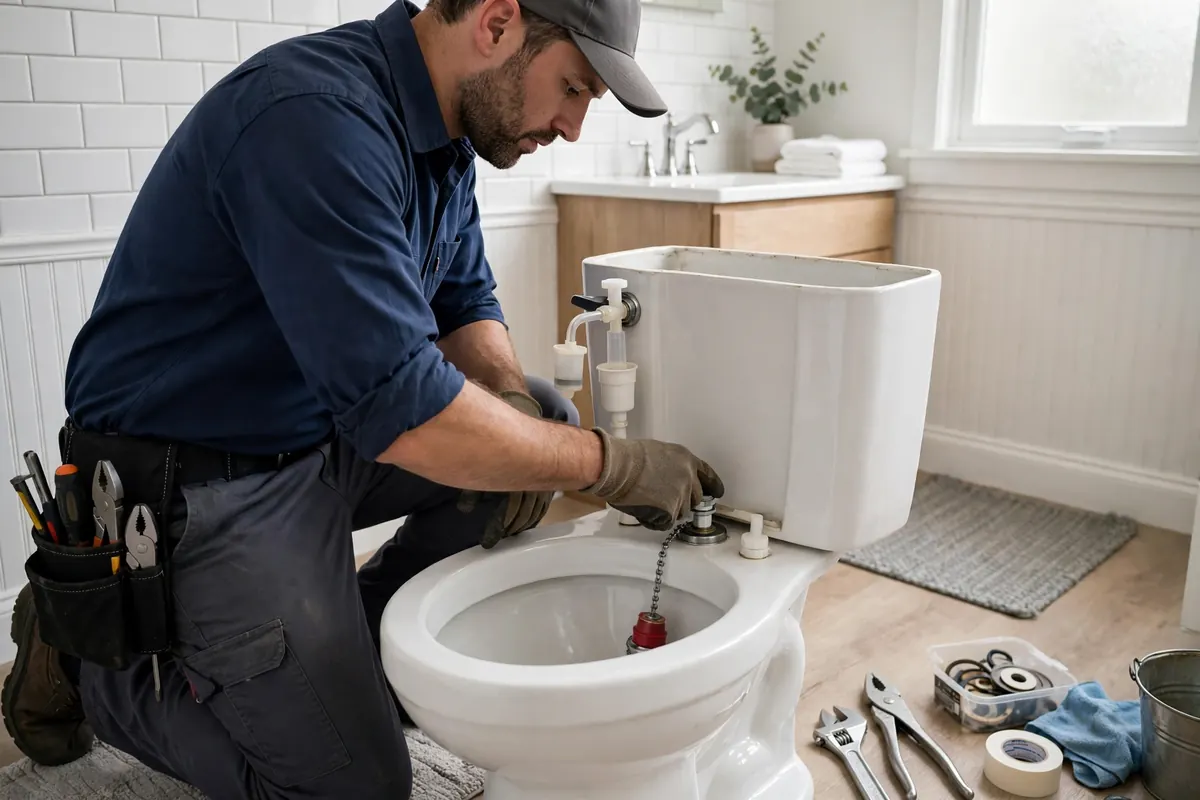
The toilet is a simple machine, and its failures are simple too. A running toilet is usually a flapper or a fill valve. A leak at the base is usually a wax seal. A weak flush is usually a clogged rim jet, a low water level, or a problem further down the line. A toilet that clogs every week is usually not a toilet problem at all — it is a drain problem wearing a toilet's clothes. This page walks through each failure, what causes it, and how it is fixed.
In Harrisburg's older homes the toilet often sits on a cast-iron flange and a clay lateral, and the fixture's problems are connected to the drain's problems. A toilet that has started clogging in a house where the drains are also slow is telling you about the lateral, not about the toilet.
Call NowSigns you need toilet repair
- A toilet that runs constantly: A toilet that runs, hisses, or refills every few minutes has a flapper that is not sealing, a fill valve that is not shutting off, or a water level set too high. A running toilet wastes water around the clock, and the sound is the first sign.
- Water at the base of the toilet: Water appearing at the base of the toilet, especially after a flush, usually means the wax seal has failed. The seal is the only thing between the toilet and the floor, and once it fails the water goes under the toilet and into the subfloor.
- A weak or incomplete flush: A toilet that swirls without clearing, that needs two flushes, or that leaves waste behind has a low water level, clogged rim jets, or a partial blockage in the trap or the drain. A weak flush that affects only one toilet is a toilet problem; a weak flush in every toilet is a drain problem.
- A toilet that clogs every week: A toilet that clogs repeatedly has a problem in the trap, a partial blockage in the branch line, or a low-flow design that cannot clear the waste. A toilet that has started clogging in a house where other drains are also slow is a lateral problem.
- A rocking toilet: A toilet that rocks when sat on has a failed wax seal, a damaged flange, or a subfloor that has rotted from a long leak. Rocking is not a nuisance; it is the seal failing, and the water is going under the toilet.
- A phantom flush: A toilet that flushes by itself, or that refills when nobody has used it, has a flapper that is leaking water from the tank into the bowl. The tank level drops, the fill valve opens, and the cycle repeats — wasting water all day.
What causes it
- A worn flapper: The flapper is a rubber seal that degrades over years in chlorinated water. Once it warps or hardens, it no longer seals the flush valve, and water leaks from the tank into the bowl. A running toilet is usually a flapper.
- A failed fill valve: The fill valve brings the tank back to its level after a flush. When it fails, it either never shuts off — the toilet runs constantly — or it never opens fully, and the tank fills slowly or not at all.
- A failed wax seal: The wax seal under the toilet compresses once, when the toilet is set, and it does not recover. A rocking toilet, a flange that has corroded, or a subfloor that has moved will break the seal, and water leaks under the toilet with every flush.
- Clogged rim jets: The rim jets under the bowl's edge deliver the water that drives the flush. In hard-water homes they clog with mineral deposits, and the flush weakens a little each year until the toilet barely clears.
- A partial drain blockage: A partial blockage in the trap or the branch line slows the flush and causes repeated clogs. The blockage is often further down the line than the toilet itself, and the toilet is the fixture that shows it first.
How the work is done
- Find which part has failed: The visit starts with the tank: the water level, the flapper, the fill valve, and the flush mechanism. A running toilet is diagnosed in the tank; a leak at the base is diagnosed at the seal; a weak flush is diagnosed at the jets and the drain.
- Replace the failed part: A worn flapper, a failed fill valve, or a clogged flush mechanism is replaced with the correct part for the toilet model. The parts are inexpensive; the diagnosis is the work.
- Reseat the toilet when the seal has failed: A failed wax seal means the toilet is lifted, the old seal and the flange are inspected, a new seal is fitted, and the toilet is reset level and bolted down. A rocking toilet also needs the flange and the subfloor checked.
- Clear the drain when the toilet is not the problem: A toilet that clogs repeatedly gets its trap and branch line checked, and the drain is cleared mechanically. If other fixtures are also slow, the problem is in the main line, and the camera comes out.
- Test the flush and the seal: After the repair the toilet is flushed several times at full load, the base is checked for leaks, and the tank is checked for a proper level and a clean shutoff. The test is what proves the repair.
What the service includes
- Fill valve and flapper replacement
- Flush mechanism repair and replacement
- Wax seal replacement and toilet reseating
- Flange inspection and repair
- Rim jet cleaning for a weak flush
- Toilet clog clearing and trap diagnosis
- Running toilet and phantom flush diagnosis
- Leak detection at the base and the supply line
Your options
Tank part replacement
A worn flapper, a failed fill valve, or a faulty flush mechanism is replaced in the tank. This is the right choice for a running toilet, a phantom flush, or a tank that fills slowly.
Reseating and resealing
The toilet is lifted, the wax seal is replaced, the flange is inspected, and the toilet is reset level. This is the right choice for a leak at the base or a rocking toilet.
Toilet replacement
A toilet with a cracked tank or bowl, a badly corroded flange, or a design that cannot flush properly is replaced rather than repaired. The replacement is sized to the rough-in and the household's needs.
Repair or replace?
A toilet with a failed flapper or fill valve is a repair — the parts are replaceable and the porcelain is sound. A toilet with a cracked tank or bowl is a replacement, because porcelain cannot be repaired. A toilet that clogs every week because its design cannot clear the waste is a replacement, because no part will fix a trap that is too small. A toilet that rocks because the subfloor has rotted from a long leak is a repair that includes the subfloor, not just the seal. The age of the toilet matters less than the condition of the porcelain and the flange: a forty-year-old toilet with sound porcelain and a good flange is a repair candidate, and a ten-year-old toilet with a cracked base is not.
Can I do this myself?
A homeowner can replace a flapper — it is the one toilet repair that needs no tools and no water shutoff beyond the tank. A fill valve is a manageable job for a confident homeowner with the water shut off. Beyond that, lifting a toilet to replace a wax seal is a two-person job that involves the flange, the subfloor, and a seal that must be set right the first time, because a toilet set wrong leaks under the floor where nobody can see it. A toilet that clogs repeatedly needs a professional diagnosis, because the problem is often in the drain rather than in the toilet.
Plumbing in Harrisburg: the local picture
Harrisburg's toilets are as old as its bathrooms. In Midtown and Uptown rowhomes, the toilet is often the original fixture in a bathroom that has not been remodelled in decades, sitting on a cast-iron flange and a clay lateral. The hard water in central Pennsylvania clogs rim jets with mineral deposits, weakening the flush a little each year. In the suburbs, Mechanicsburg and Camp Hill ranches have toilets from the post-war build, and Hershey's older homes near the factory carry the same era. Across the metro, the toilet's problems are the house's problems: a wax seal that has been compressed for forty years, a flange that has corroded, a lateral that is narrowing — and a toilet that shows the symptoms first because it is the fixture that is used most.
The water matters. Central Pennsylvania's hard water leaves mineral deposits in rim jets and in fill valves, and a toilet that flushes weakly in a hard-water home is often a toilet whose jets have narrowed over years. Cleaning the jets restores the flush without replacing the toilet, and it is the repair that is most often overlooked.
Mistakes to avoid
- Ignoring a running toilet: A running toilet wastes water around the clock, and the sound is easy to tune out. A toilet that refills every few minutes is leaking water from the tank into the bowl, and the flapper is the usual cause.
- Ignoring water at the base: Water at the base of the toilet is a failed wax seal, and the water is going under the toilet and into the subfloor with every flush. A subfloor that rots from a long leak is a far larger repair than a seal.
- Using chemical cleaners in the tank: Chemical cleaners that sit in the tank degrade the flapper and the fill valve seals. They are the most common cause of a flapper failing early, and they turn a simple repair into a repeated one.
- Flushing wipes: Wipes do not break down like toilet paper, and they are a leading cause of toilet and main-line blockages. They belong in the bin, even when the packaging says otherwise.
- Forcing a clog with more flushes: Flushing a clogged toilet again only adds water to a bowl that has nowhere to go. One flush, then a plunger — and if the plunger does not clear it, the blockage is past the trap.
What to have ready before you call
- Note whether the toilet runs, leaks at the base, flushes weakly, or clogs
- Note whether other fixtures are also slow — that points to the drain, not the toilet
- Clear access to the toilet and the shutoff valve behind it
- Note the age of the toilet if you know it, and whether it has been repaired before
- Do not use chemical cleaners in the tank before the visit
What shapes the scope of the work
Toilet work varies with the failed part and the access. A flapper replacement is a different job from a toilet that must be lifted, resealed and reset on a corroded flange, and a toilet that needs replacing involves the new fixture, the rough-in, and the disposal of the old one. The factors that shape the scope are which part has failed, the condition of the flange and the subfloor, whether the problem is in the toilet or in the drain, and whether the toilet itself is worth repairing. The diagnosis is what sets the scope: it shows whether the problem is in the tank, at the seal, or further down the line.
How to choose a provider
Ask what the provider found in the tank before agreeing to a repair. A provider who can show you the worn flapper, the failed fill valve, or the clogged rim jets is diagnosing rather than guessing. Ask whether the base will be checked for a leak and whether the flange will be inspected when the toilet is lifted, because a seal replacement on a corroded flange will fail again. The provider who checks the tank, the seal, the flange and the drain is the one whose repair will still be holding next year.
Other plumbing services
Questions, answered
Why does my toilet keep running?
A worn flapper that no longer seals the flush valve, a fill valve that does not shut off, or a water level set too high. Water leaks from the tank into the bowl, the level drops, and the fill valve opens again.
Why is there water at the base of my toilet?
The wax seal under the toilet has failed. The seal is the only thing between the toilet and the floor, and once it fails the water goes under the toilet and into the subfloor with every flush.
Why does my toilet clog every week?
A partial blockage in the trap or the branch line, clogged rim jets weakening the flush, or a problem further down the line. A toilet that clogs while other fixtures are also slow is a drain problem, not a toilet problem.
Why does my toilet flush by itself?
A flapper leaking water from the tank into the bowl. The tank level drops, the fill valve opens to refill it, and the cycle repeats. It is called a phantom flush, and the flapper is the usual cause.
Can a cracked toilet be repaired?
No. A cracked tank or bowl cannot be repaired — the toilet needs replacement. Porcelain does not take a patch that holds under pressure.
Why is my toilet rocking?
A failed wax seal, a damaged flange, or a subfloor that has rotted from a long leak. Rocking is the seal failing, and the water is going under the toilet.
Should I put chemical cleaners in the toilet tank?
No. Chemical cleaners that sit in the tank degrade the flapper and the fill valve seals, and they are the most common cause of a flapper failing early.
When should a toilet be replaced instead of repaired?
When the tank or bowl is cracked, when the design cannot flush properly, or when the flange and subfloor damage make repair impractical. A toilet with sound porcelain and a good flange is usually a repair candidate.
Need toilet repair? Call Now.
Talk with a local plumbing professional about your home. Hours: Mon–Fri 7:00 AM–10:00 PM ET · Sat 8:00 AM–10:00 PM ET · Sun 7:00 AM–9:00 PM ET.
Call NowGet in touch
Call Now from any page and you will be connected with a local plumbing professional serving Harrisburg and the surrounding metro. You can also reach us by email at hello@harrisburgplumbingpros.com.
Hours: Mon–Fri 7:00 AM–10:00 PM ET · Sat 8:00 AM–10:00 PM ET · Sun 7:00 AM–9:00 PM ET.
Call Now