Home › Services › Sewer Camera Inspection
Plumbing · Harrisburg, PASewer Camera Inspection in Harrisburg, PA
A sewer camera inspection is the one step that turns a guess about an underground pipe into evidence. A small waterproof camera on a flexible cable is run through the lateral from a cleanout or a pulled toilet, and the operator watches the inside of the pipe in real time — every joint, every root, every crack, every belly — and records it. This page explains what the inspection shows, when it is needed, and what happens with the results.
Talk with a local plumbing professional
Hours: Mon–Fri 7:00 AM–10:00 PM ET · Sat 8:00 AM–10:00 PM ET · Sun 7:00 AM–9:00 PM ET
Call NowWhat is sewer camera inspection?
A sewer camera is a waterproof camera head, usually with a light, on the end of a push cable that can travel the full length of a residential lateral. The operator feeds the cable through the pipe while watching the live image, and a transmitter in the camera head lets a locator above ground mark the exact position and depth of anything the camera finds. The run is recorded, so the homeowner can see the same images the operator saw.
The inspection shows the material of the pipe, the condition of every joint, root intrusion, cracks, breaks, collapses, bellies where the pipe has lost its slope, offsets where one section has shifted, scale and grease buildup, and any foreign object in the line. It also shows the overall condition: a lateral can look rough in one place and sound everywhere else, and that distinction is what separates a spot repair from a replacement.
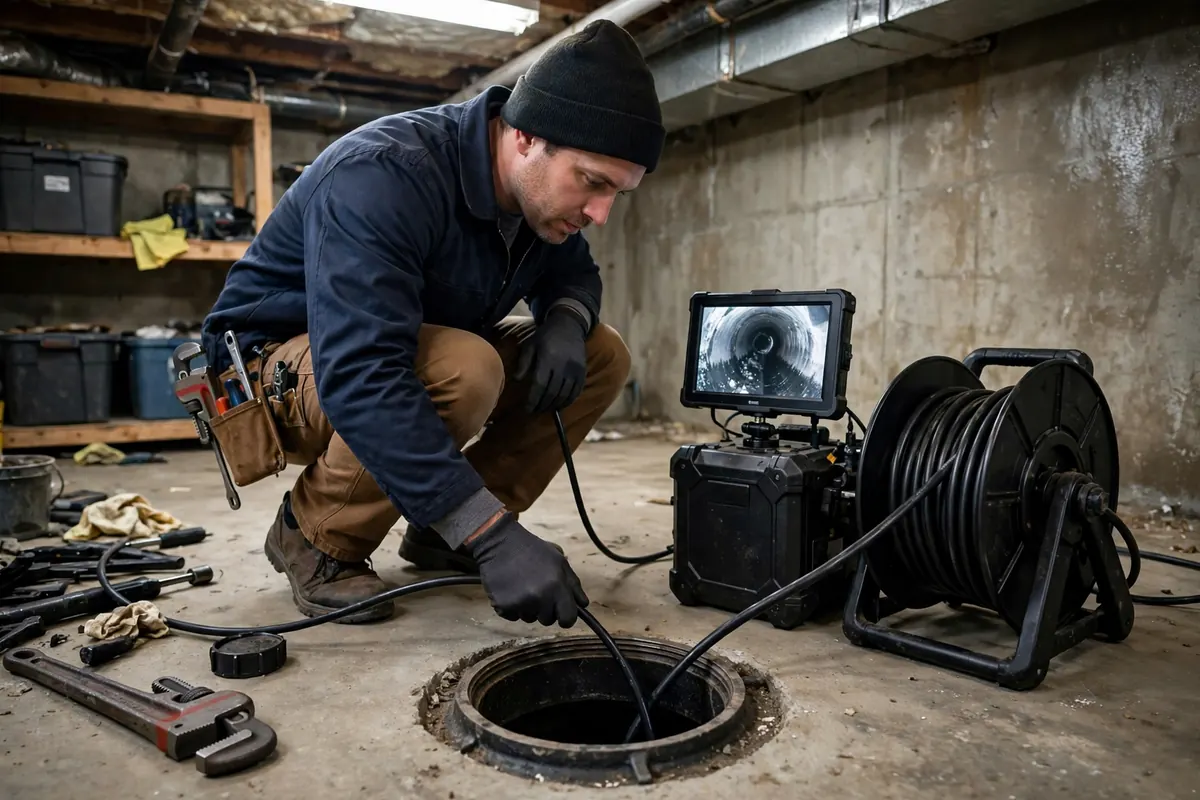
In Harrisburg the camera is the most useful diagnostic in plumbing, because the pipes it inspects are old and underground. The median home was built in 1947, and the original clay or cast-iron lateral under a pre-1970 home has been in the ground for generations. Nobody can see the condition of that pipe from the surface, and a drain that has been cleared three times without a camera look has been treated three times for a symptom nobody has seen.
An inspection is not a repair, and it should not be sold as one. It is a diagnostic that tells you whether the pipe needs cleaning, a spot repair, a relining, or a full replacement — and it tells you where, in feet from the access point, so any excavation starts at the right place.
Call NowSigns you need sewer camera inspection
- A drain that clogs again after clearing: A lateral that clogs, gets cleared, and clogs again within weeks or months has a cause inside the pipe. The camera finds it — roots, a break, a belly — instead of a fourth clearing of the same symptom.
- Several fixtures slow at once: When the kitchen, the bathrooms and the laundry all slow together, the restriction is in the shared lateral. A camera run shows whether the restriction is buildup, roots, or a damaged section.
- A backup in the lowest fixture: Sewage or water in a basement floor drain or a ground-floor tub means the main line is blocked or damaged. After the line is cleared, a camera run shows what caused the backup so it does not return.
- A wet patch or green strip in the yard: A soggy patch or a line of fast-growing grass from the house to the street follows the lateral. A camera run confirms whether the pipe is leaking and where.
- Before buying an older Harrisburg home: A pre-purchase camera inspection is the standard check for a home with an original lateral. It is the only way to know the condition of a pipe that is eighty years old and buried under the front yard.
- Before a repair is recommended: Any recommendation for a lateral repair, a relining, or a replacement should start with a camera record. A repair recommended without one is a guess, and the camera is what turns it into a plan.
What causes it
- Root intrusion at clay joints: Clay tile laterals have joints every few feet, and roots enter through them seeking water. The camera shows the root mat, its size, and how many joints are affected — which decides whether the fix is a cleaning, a spot repair, or a replacement.
- Cracks and breaks from ground movement: Freeze-thaw cycles move the ground a little every year in central Pennsylvania, and a clay or cast-iron lateral shifts with it. The camera shows cracks, breaks and offsets, and the locator marks their exact depth and position on the surface.
- Bellies from settlement: A section of pipe that has settled holds water instead of draining it. The camera shows standing water in the belly and the solids that settle there, and the locator shows how deep the low spot sits.
- Scale and grease narrowing: Cast-iron laterals corrode from the inside, and the rough scale grabs grease and debris. The camera shows how much of the pipe's diameter is left, which decides whether a jet cleaning will restore it or whether the pipe is too far gone.
- Collapsed sections: A lateral can collapse where the soil has washed out from under it or where the pipe wall has failed. The camera stops at the collapse, and the locator marks the spot — which is exactly where the excavation needs to start.
How the work is done
- Find the access point: The camera enters through a cleanout if the house has one, or through a pulled toilet if it does not. The access point decides how much of the lateral can be seen — a cleanout at the house shows the run to the street, which is the section that matters.
- Run the camera to the main: The operator feeds the cable through the lateral to the municipal main, watching the live image and noting the distance of each defect. The run is recorded so the findings can be looked over and shared.
- Locate defects from the surface: A locator follows the transmitter in the camera head and marks each defect on the surface with its depth. This is what makes a later excavation precise instead of a trench across the yard.
- Go through the recording together: The operator walks through the recording with the homeowner: what the pipe is made of, where the problems are, how serious each one is, and what the options are. The recording is the evidence for whatever is recommended next.
- Decide the next step: A sound pipe with buildup gets a cleaning. A single break gets a spot repair. A line with multiple failures gets a replacement or a relining. The decision comes from the recording, not from the age of the house.
What the service includes
- Full camera run from the house to the municipal main
- Live viewing and a recording of the inspection
- Surface location and depth marking of every defect
- Pipe material and condition assessment
- Written findings with distances from the access point
- Repair, relining or replacement recommendation from the recording
- Cleanout location advice for future access
Your options
Standard lateral inspection
A camera run through the full lateral, with a recording and a findings report. This is the inspection for a recurring clog, a backup, a pre-purchase check, or a repair recommendation.
Inspection with cleaning
The line is cleared or jetted first, then camera-inspected, so the camera sees the pipe wall rather than the blockage. This is the right sequence when the line is currently blocked.
Inspection with location marking
Every defect is marked on the surface with its depth, so a spot repair can be excavated precisely. This is the inspection that precedes any digging.
Repair or replace?
A camera inspection is the step that decides between repair and replacement, and it does so with pictures rather than opinions. A lateral with one broken joint and sound pipe elsewhere is a spot repair. A lateral with roots at every joint, a belly, and a collapse is a replacement or a relining, because fixing one failure leaves the others in place. The inspection also catches the case where no repair is needed at all: a sound pipe with heavy buildup is a cleaning job, and the money that would have gone to a repair stays in the homeowner's pocket. That is the value of the inspection — it prevents the wrong job as often as it confirms the right one.
Can I do this myself?
There is no homeowner version of a sewer camera inspection. The equipment is a waterproof camera on a long push cable with a surface locator, and the skill is in reading what the image shows — telling a belly from a break, a root mat from a grease mat, a sound clay joint from a separated one. What the homeowner can do is ask for the recording and watch it with the operator, so the recommendation that follows is one they have seen the evidence for. A provider who will not show the recording is asking to be trusted without evidence, and an underground pipe is the wrong place for that.
Plumbing in Harrisburg: the local picture
Harrisburg is a camera-inspection city because its pipes are old, buried, and owned by the homeowner. The median home was built in 1947, and the original lateral under a Midtown rowhome or an Allison Hill house has been in the ground for more than eighty years, under a front yard with mature trees. In Shipoke, where the floodplain has taken river water in 1972, 2004 and 2011, laterals have been soaked and shifted repeatedly. In the suburbs, Mechanicsburg and Camp Hill ranches have long laterals to the street, and Carlisle's borough homes carry the same clay era. Across the metro, the lateral is the least-known part of the house — and the camera is the only way to know it.
The inspection matters most at two moments: when a drain keeps clogging, and when a home is changing hands. A pre-purchase inspection of an older Harrisburg home can reveal a lateral that needs a full replacement — a job that shapes the negotiation — or it can confirm a sound line and remove the worry entirely. Either way, the recording is worth more than a guess.
Mistakes to avoid
- Clearing three times without a camera look: Each clearing treats the symptom. After the second recurrence, the camera is the step that finds the cause — and the money spent on repeated clearings would have paid for it.
- Accepting a repair recommendation without a recording: A lateral repair, relining or replacement recommended without a camera record is a guess. Ask to see the inside of the pipe before agreeing to dig it up.
- Inspecting only part of the line: A camera run that stops at the first blockage has not inspected the lateral. The line should be cleared first, then run to the main, so the full length is seen.
- Ignoring the pre-purchase inspection: An older Harrisburg home with an original lateral is a candidate for a pre-purchase camera inspection. It is the only way to know the condition of a buried pipe before the purchase is final.
- Forgetting the cleanout: A house without an accessible cleanout makes every future inspection and cleaning harder. Installing one during a repair is a small step that pays for itself at the next visit.
What to have ready before you call
- Clear access to the basement cleanout or the lowest toilet
- Note which fixtures are affected and how often the line has clogged
- Note any wet patches or green strips in the yard
- Ask for the recording and the written findings with distances
- Keep the recording with the house records — the next owner will want it
What shapes the scope of the work
A camera inspection is a diagnostic, and its scope is set by access and length. A house with an accessible cleanout and a short lateral to the street is a straightforward run. A house without a cleanout needs a toilet pulled to gain access, and a long lateral to a distant main takes a longer cable run. The value of the inspection is not in the run itself but in what it prevents: a repair dug in the wrong place, a replacement recommended for a pipe that only needed cleaning, or a purchase made without knowing the lateral is collapsed. The recording is the deliverable, and it is what every later decision is built on.
How to choose a provider
Ask three questions before booking an inspection: will the run go to the main, will it be recorded, and will defects be located from the surface with depths marked. A provider who answers yes to all three is doing a full inspection. Ask to watch the live image during the run, and ask for the findings in writing with distances from the access point. The provider who shows you the inside of your pipe and explains what each image means is giving you the evidence to decide what happens next.
Other plumbing services
Questions, answered
What will the camera find in my lateral?
It shows the pipe material, the condition of every joint, root intrusion, cracks, breaks, bellies and offsets — and the distance of each problem from the access point, so a repair can be planned from evidence rather than from a guess.
How far can the camera go?
A residential camera run goes from the house to the municipal main — the full length of the lateral. The operator notes the distance of each defect from the access point.
Do I need a cleanout for a camera inspection?
A cleanout is the easiest access point. Without one, the camera enters through a pulled toilet. Installing a cleanout during a repair makes every future inspection simpler.
Should I get a camera inspection before buying an older home in Harrisburg?
Yes. A pre-purchase inspection is the only way to know the condition of an original clay or cast-iron lateral under a pre-1970 home, and the findings can shape the purchase decision.
Can the camera find the exact location of a break?
Yes. A transmitter in the camera head lets a locator mark the defect's position and depth on the surface above, so any excavation starts at the right place.
What happens after the inspection?
The operator goes through the recording with you and recommends the next step from what it shows: cleaning for a sound pipe with buildup, a spot repair for a single break, or a replacement or relining for a line with multiple failures.
Will the camera damage my pipes?
No. The camera is a small waterproof head on a flexible cable, pushed through the pipe by hand. It does not cut, scrape or pressurise the line.
How often should a lateral be inspected?
Once, as a baseline, for any older home that has never had one — and again whenever a drain starts clogging repeatedly, after a backup, or before a repair is recommended.
Need sewer camera inspection? Call Now.
Talk with a local plumbing professional about your home. Hours: Mon–Fri 7:00 AM–10:00 PM ET · Sat 8:00 AM–10:00 PM ET · Sun 7:00 AM–9:00 PM ET.
Call NowGet in touch
Call Now from any page and you will be connected with a local plumbing professional serving Harrisburg and the surrounding metro. You can also reach us by email at hello@harrisburgplumbingpros.com.
Hours: Mon–Fri 7:00 AM–10:00 PM ET · Sat 8:00 AM–10:00 PM ET · Sun 7:00 AM–9:00 PM ET.
Call Now