Home › Services › Sump Pump Installation & Repair
Plumbing · Harrisburg, PASump Pump Installation & Repair in Harrisburg, PA
A sump pump is the appliance that stands between a Harrisburg basement and the Susquehanna valley's water table. Sump pump installation and repair in Harrisburg, PA covers the pump, the pit, the discharge line and the backup power that keep a basement dry through spring thaw, heavy rain, and the high water table that follows the river. This page explains how a sump system works, what fails in it, and why the pump that has sat idle all winter is the one most likely to fail on the first warm weekend.
Talk with a local plumbing professional
Hours: Mon–Fri 7:00 AM–10:00 PM ET · Sat 8:00 AM–10:00 PM ET · Sun 7:00 AM–9:00 PM ET
Call NowWhat is sump pump installation & repair?
A sump pump sits in a pit at the lowest point of the basement floor. Groundwater collects in the pit, a float switch rises with the water, and the pump pushes the water out through a discharge line to the yard or a storm drain. A check valve on the discharge line stops the water from flowing back into the pit when the pump stops. The system is automatic: it runs when the water rises and stops when the pit is empty.
Installation means more than dropping a pump in a pit. The pit must be sized to the water load, the pump must be sized to the lift and the distance of the discharge, the discharge line must run to a place where the water does not come back, and the line must be protected from freezing where it leaves the house. A backup power supply — a battery backup or a water-powered backup — keeps the pump running when the power goes out, which is often when the rain is heaviest.
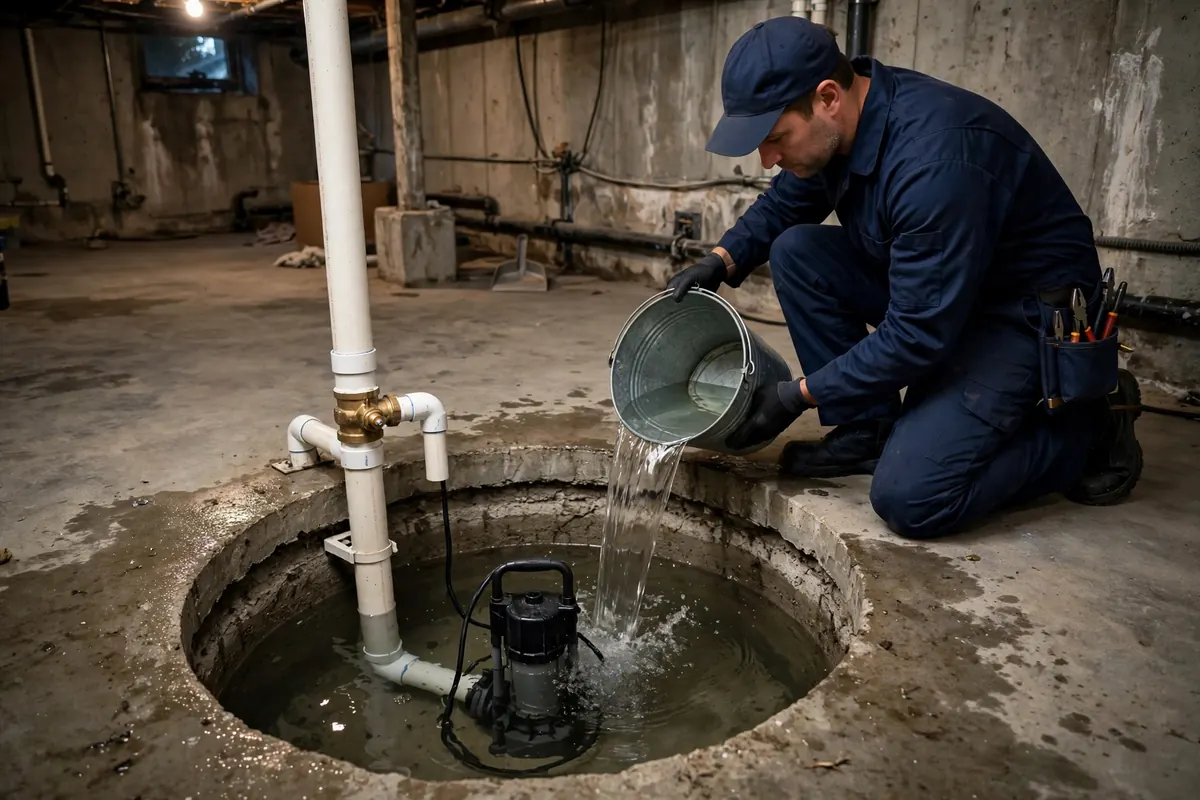
Harrisburg's water problem is seasonal and predictable. Spring thaw brings melting snow and ice that overwhelm drainage, and heavy rain raises the water table across the river valley. A basement that is dry all winter can take water in a single April weekend, and the pump that has not run since November is asked to work at full capacity on the first day it matters. A frozen discharge line, a stuck float switch, or a pump that has seized from sitting idle are the three failures that arrive together in spring.
The sump system is only as strong as its weakest part. The pump, the pit, the check valve, the discharge line and the power supply all have to work, and the failure of any one of them floods the basement just as surely as a failed pump.
Call NowSigns you need sump pump installation & repair
- Water in the basement after rain or thaw: Water on the basement floor after heavy rain or spring thaw means the sump system is not keeping up — the pump is failing, the discharge is blocked, or the water load is larger than the system was built for.
- A pump that runs constantly: A pump that never stops running is working against a problem: a check valve that has failed and lets water flow back, a discharge line that is blocked, or a water load that has grown beyond the pump's capacity.
- A pump that never runs: A pump that stays silent while water rises in the pit has a failed float switch, a seized motor, a tripped breaker, or a power problem. A pump that has sat idle all winter is the most likely to seize.
- A frozen or blocked discharge line: A discharge line that freezes where it leaves the house, or that is blocked by debris, stops the system even when the pump is working. The pump runs, the water goes nowhere, and the pit overflows.
- Noisy operation or vibration: A pump that grinds, rattles or vibrates is wearing out — a failing bearing, a damaged impeller, or a pump that is running dry because the float switch is set wrong. Noise is the warning before the failure.
- A musty smell or damp walls in the basement: Persistent dampness, a musty smell, or efflorescence on basement walls means groundwater is entering faster than the sump system is removing it. The system is undersized, failing, or missing entirely.
What causes it
- Float switch failure: The float switch is the most common point of failure in a sump pump. It sticks, it tangles on the pit wall, or its contacts wear out, and the pump either never starts or never stops. A stuck switch is the most common reason a basement floods.
- Frozen discharge line: A discharge line that runs above ground or through an unheated space freezes in winter, and the pump cannot push water through ice. The line must be sloped to drain, buried below the frost line where it runs outside, or fitted with a freeze-resistant termination.
- Power failure during a storm: Heavy rain and power cuts arrive together, and a sump pump without backup power stops exactly when the water load is highest. A battery backup or a water-powered backup is the part of the system that matters most on the worst night.
- Undersized pump or pit: A pump sized for a normal year cannot keep up with a wet spring, and a pit that is too small cycles the pump on and off until the switch wears out. The system must be sized to the water load the house actually sees, not to the average year.
- Check valve failure: A failed check valve lets the water in the discharge line flow back into the pit when the pump stops, so the pump cycles constantly and wears out. The symptom is a pump that runs every few minutes, all day.
How the work is done
- Assess the water load: The visit starts with the water: where it enters, how much arrives in a heavy rain, and where the water table sits. The load decides the pump size, the pit size, and whether a backup is needed.
- Check the pump, the switch and the power: The pump is tested, the float switch is checked for unobstructed movement, and the power supply and breaker are verified. A pump that has seized from sitting idle is found by testing, not by waiting for the next rain.
- Check the discharge line: The discharge line is traced from the pump to its termination, checking for freezing, blockage, and a termination that lets the water come back toward the house. The line must carry water away, not in a circle.
- Repair or replace the failed part: A failed switch, a failed check valve, or a seized pump is replaced with the right part for the system. A pump that has reached the end of its service life is replaced rather than repaired.
- Test at full load and fit the backup: The system is tested by filling the pit and watching the pump cycle, and the backup power is tested by cutting the power. The system is proven under load, not assumed to work.
What the service includes
- Sump pump diagnosis, repair and replacement
- Float switch replacement and adjustment
- Check valve replacement
- Discharge line clearing, rerouting and freeze protection
- Battery backup and water-powered backup installation
- New sump pit and pump installation
- Pump sizing to the house's actual water load
- Full-load testing of the pump and the backup
Your options
Pump repair
A failed float switch, a failed check valve, or a blocked discharge line is repaired and the pump returns to service. This is the right choice when the pump itself is sound and the failure is in a part around it.
Pump replacement
A pump that has seized, that is undersized for the water load, or that has reached the end of its service life is replaced with a correctly sized unit. This is the right choice when the pump itself is the problem.
New sump system
A home without a sump system, or with a pit that is too small and a pump that cannot keep up, gets a new pit, pump, discharge and backup sized to the water load the house actually sees.
Repair or replace?
A sump pump with a failed float switch is a repair — the switch is a replaceable part and the pump has years left. A pump that has seized from sitting idle, that grinds when it runs, or that is undersized for the water load is a replacement, because the pump itself is the problem. The age matters too: a pump that has served for a decade in a Harrisburg basement has done its work, and a new pump with a backup is a better investment than another repair on a worn motor. The backup is the part that decides the question on the worst night: a pump without backup power is a pump that stops when the power goes out, which is when the rain is heaviest.
Can I do this myself?
A homeowner can test a sump pump: pour water into the pit and watch the pump start, run, and stop. That test is worth doing every spring, before the thaw, because it finds a seized pump while there is still time to fix it. A homeowner can also check that the discharge line is clear and that the water goes somewhere sensible. Beyond that, sizing a pump, fitting a backup, and running a discharge line that will not freeze are professional jobs. The most useful homeowner habit is the spring test — a pump that has sat idle all winter is the one most likely to fail on the first warm weekend.
Plumbing in Harrisburg: the local picture
Harrisburg's sump problem is the Susquehanna. The river valley's water table rises with spring thaw and heavy rain, and the basements along the river — Shipoke most of all, where the floodplain has taken river water in 1972, 2004 and 2011 — sit in the path of that water. Spring thaw brings melting snow and ice that overwhelm drainage, and a sump pump that has sat idle all winter is asked to work at full capacity on the first warm weekend. Sloped lots and poor exterior grading add to the load: water runs toward the house instead of away from it, and the sump system carries what the grading should have shed.
The metro spreads the same load across different ground. Mechanicsburg and Camp Hill have post-war ranches with basements that take water in wet springs. Hershey's homes near the factory sit on ground that holds water after heavy rain. Carlisle's borough houses have basements that have taken water for generations. Across the metro, the pattern is the same: a wet spring, a pump that has not run since November, and a basement that floods on the first warm weekend.
Mistakes to avoid
- Never testing the pump: A pump that is never tested is a pump whose failure is discovered by a flooded basement. Pouring water into the pit every spring, before the thaw, finds a seized pump while there is still time to fix it.
- No backup power: Heavy rain and power cuts arrive together. A sump pump without a battery backup stops exactly when the water load is highest, and the basement floods on the worst night of the year.
- A discharge line that freezes: A discharge line that runs above ground or through an unheated space freezes in winter, and the pump cannot push water through ice. The line must be sloped to drain and protected from freezing.
- Discharging water next to the house: A discharge line that ends beside the foundation sends the water straight back into the ground around the house, where it returns to the pit. The water must go away from the house, not in a circle.
- Ignoring a pump that runs constantly: A pump that never stops is working against a failed check valve, a blocked discharge, or a load larger than its capacity. Constant running wears the pump out, and the failure follows soon after.
What to have ready before you call
- Test the pump every spring: pour water into the pit and watch it start, run and stop
- Note whether the pump runs constantly, never runs, or makes noise
- Check where the discharge line ends and whether the water goes away from the house
- Note whether the basement takes water in wet weather, and how much
- Clear access to the pit, the pump and the electrical outlet
What shapes the scope of the work
Sump work varies with the system and the water load. A float switch replacement on an accessible pump is a different job from a new pit and pump in a finished basement, and a battery backup installation is a different job again. The factors that shape the scope are the pump size needed for the water load, the pit size, the discharge route and its freeze exposure, and whether a backup power supply is fitted. The assessment is what sets the scope: it shows where the water enters, how much arrives in a heavy rain, and whether the existing system can carry it.
How to choose a provider
Ask how the provider will size the system. A provider who asks about the water load — where the water enters, how much arrives in a heavy rain, whether the basement has flooded before — is sizing to your house rather than to a catalogue. Ask whether the backup power will be tested by cutting the power, and ask where the discharge line ends. The provider who talks about the water load, the backup, and the discharge route before talking about the pump is the one whose system will still be working on the worst night of the year.
Other plumbing services
Questions, answered
Why is my basement flooding in spring?
Spring thaw and heavy rain raise the water table across the Susquehanna valley, and a sump pump that has sat idle all winter is asked to work at full capacity on the first warm weekend. A seized pump, a stuck float switch, or a frozen discharge line are the usual causes.
How often should I test my sump pump?
Every spring, before the thaw. Pour water into the pit and watch the pump start, run and stop. A pump that has sat idle all winter is the most likely to fail when it is needed.
Do I need a battery backup for my sump pump?
Yes, if the basement takes water. Heavy rain and power cuts arrive together, and a pump without backup power stops exactly when the water load is highest.
Why does my sump pump run constantly?
A failed check valve lets water flow back into the pit, a blocked discharge line stops the water from leaving, or the water load is larger than the pump's capacity. Constant running wears the pump out.
Where should the discharge line go?
Away from the house, to a place where the water does not come back toward the foundation. A line that ends beside the house sends the water straight back into the ground around it.
Can a sump pump discharge line freeze?
Yes. A line that runs above ground or through an unheated space freezes in winter, and the pump cannot push water through ice. The line must be sloped to drain and protected from freezing.
What is a float switch and why does it fail?
The float switch rises with the water in the pit and starts the pump. It is the most common point of failure: it sticks, tangles on the pit wall, or its contacts wear out.
Does a sump pump need maintenance?
Yes. The pit should be cleared of debris, the float switch checked for unobstructed movement, and the pump tested every spring. A pump that has served for a decade in a Harrisburg basement is near the end of its service life.
Need sump pump installation & repair? Call Now.
Talk with a local plumbing professional about your home. Hours: Mon–Fri 7:00 AM–10:00 PM ET · Sat 8:00 AM–10:00 PM ET · Sun 7:00 AM–9:00 PM ET.
Call NowGet in touch
Call Now from any page and you will be connected with a local plumbing professional serving Harrisburg and the surrounding metro. You can also reach us by email at hello@harrisburgplumbingpros.com.
Hours: Mon–Fri 7:00 AM–10:00 PM ET · Sat 8:00 AM–10:00 PM ET · Sun 7:00 AM–9:00 PM ET.
Call Now