Home › Services › Emergency Plumber
Plumbing · Harrisburg, PAEmergency Plumber in Harrisburg, PA
When water is running where it should not be, the next hour decides how much of your home gets wet. An emergency plumber in Harrisburg, PA is the call for burst pipes, a major leak, a sewer backup, a water heater that has failed open, or a home with no water at all. This page explains what counts as a plumbing emergency, what to do in the first minutes, and what happens from the moment you call.
Talk with a local plumbing professional
Hours: Mon–Fri 7:00 AM–10:00 PM ET · Sat 8:00 AM–10:00 PM ET · Sun 7:00 AM–9:00 PM ET
Call NowWhat is emergency plumber?
Emergency plumbing covers the failures that cannot wait for a weekday appointment because water is actively damaging the home or the home has lost a basic service. A burst supply pipe, a sewage backup into a tub or basement floor drain, a water heater leaking across a utility room floor, a main line break, and a complete loss of water all sit in this category. So does a gas smell near a water heater or furnace line, which is a leave-the-house-first situation, not a wait-and-see one.
What makes a job an emergency is not the fixture involved but the consequence of waiting. A dripping faucet can wait. A ceiling stain that is growing by the hour cannot, because the water is still moving behind the drywall. A slow drain can wait. A toilet that overflows every time it is flushed cannot, because the next flush adds to the water already on the floor. The test is simple: if waiting until tomorrow means more water damage, more contamination, or no water for the household, it is an emergency call.
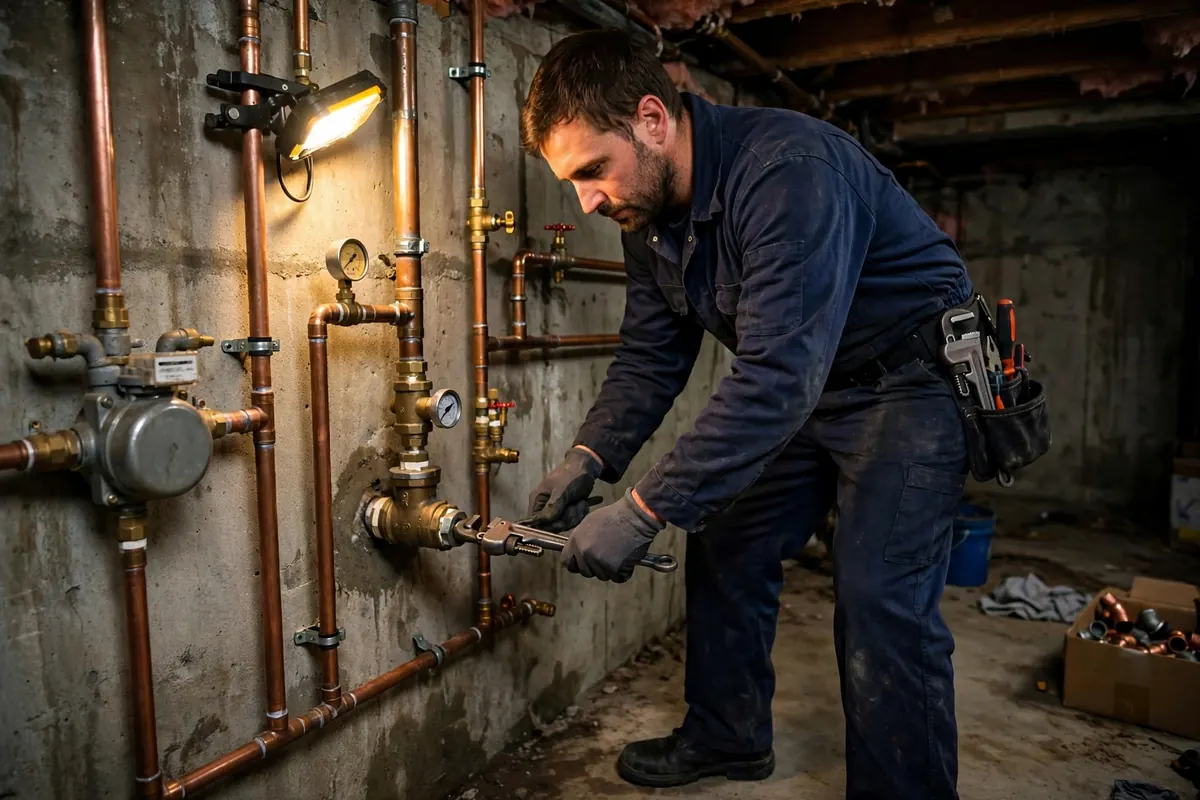
Harrisburg winters make plumbing emergencies a seasonal certainty rather than a rare event. The city sees around 101 nights a year at or below freezing, and a pipe that freezes overnight often bursts as it thaws the next morning. On January 28, 2025, Harrisburg firefighters answered more than two dozen burst-pipe calls in a single day as temperatures warmed after a freeze. Older homes carry the most risk: the median Harrisburg home was built in 1947, and 43 percent of homes are older than 1940, with galvanized steel supply lines and clay or cast-iron laterals that have been in the ground for generations.
An emergency call is not the same as a routine appointment. The work starts with stopping the water, then finding the failure, then making the home safe and dry before a permanent repair is planned. The local professionals this site connects you with serve Harrisburg and the surrounding metro — Mechanicsburg, Camp Hill, Hershey, Carlisle, Lemoyne, Hummelstown, Enola and New Cumberland — and the hours on this site are the hours the line is answered: Monday to Friday 7 in the morning to 10 at night, Saturday 8 to 10, and Sunday 7 to 9.
Call NowSigns you need emergency plumber
- Water where it should not be: Puddles on a floor, water running down a wall, a ceiling stain that is still wet to the touch, or a carpet that is damp with no obvious source all mean water is moving inside the structure right now. The visible water is usually a fraction of what is already inside the wall or under the floor.
- No water at any tap: When every tap in the house is dry, the problem is at the main supply, the main shutoff, or a frozen or broken main line. One dry tap is a fixture problem; every tap dry is a whole-house problem and it belongs on an emergency call.
- A sewer smell or sewage in a fixture: Sewage coming up through a basement floor drain, a tub, or a shower is a health hazard, not a smell problem. Stop using water in the house, keep people and pets out of the affected room, and call. A single gurgling drain can be a vent issue; sewage in a fixture is a backup.
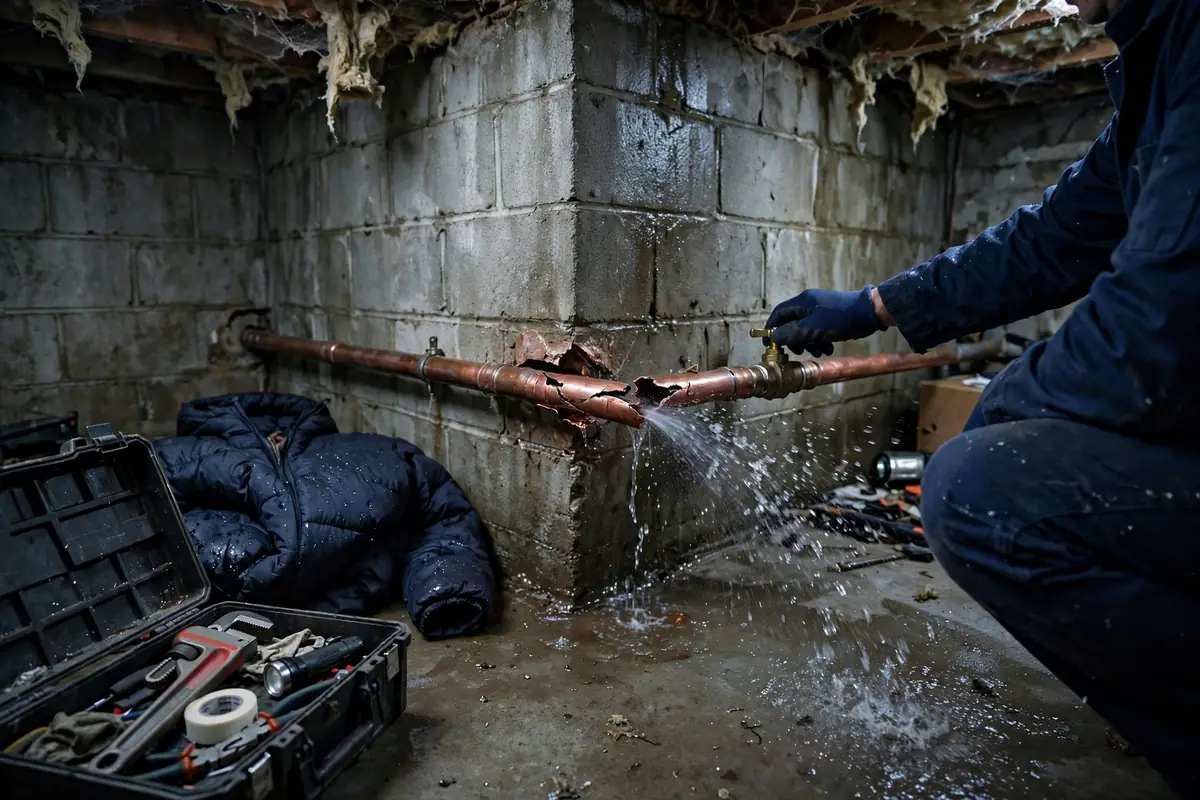
- A burst or split pipe: A pipe that has split open sprays or pours water until the main is shut off. In Harrisburg this most often happens after a hard freeze, in an exterior wall, an unheated crawl space, a garage, or an attic run. Shut the main valve first, then call.
- A water heater leaking heavily: A water heater that is leaking from the tank itself, or from a fitting in a steady stream, will keep filling the floor until the water to the heater is shut off. A small drip from a relief-valve pipe is different from a tank leak; a tank leak does not stop on its own.
- Banging, hissing or a sudden pressure change: A loud bang when a tap closes, a hiss inside a wall, or a sudden drop in pressure across the whole house can mean a line has broken or a valve has failed. A hiss with no visible water often means the break is inside a wall or under a slab.
What causes it
- Frozen pipes: Water expands by about nine percent when it freezes, and the pressure it creates is enough to split copper, PEX and galvanized steel alike. Harrisburg's freeze-thaw winters put exterior-wall runs, crawl spaces, garages and attic lines at risk on any night that drops into the low twenties and stays there.
- Aged galvanized steel: Much of Harrisburg's housing stock still carries galvanized steel supply lines from the 1940s and 1950s. The pipe corrodes from the inside, narrowing until flow drops, then failing at a threaded joint or a weakened section. A line that has been narrowing for years can fail without warning.
- Sewer lateral failure: Clay tile and cast-iron laterals under older Harrisburg homes are at or past the end of their service life. Tree roots enter through joints, ground settlement shifts the line, and a partial blockage becomes a full backup during heavy use or heavy rain.
- Water heater tank failure: A tank water heater corrodes from the inside over its service life. The failure usually shows up as a leak at the base of the tank, and once a tank starts leaking through its wall, the leak only grows. Sediment and hard water in central Pennsylvania shorten tank life when the heater is never flushed.
- High water pressure and failed valves: Municipal pressure that runs high, or a pressure-reducing valve that has failed, stresses every joint, hose and appliance connection in the house. The failure often appears at the weakest point — a supply hose, a toilet fill valve, or an old soldered joint.
How the work is done
- Stop the water first: The call starts with the shutoff. The main water valve in most Harrisburg rowhomes and older borough houses is in the basement on the front wall, where the water service enters from the street, close to the meter. In a post-war ranch it is more often in a utility room or near the water heater. Shutting it off stops the damage from growing.
- Describe what you see: The professional will ask where the water is, whether it is clean or sewage, whether any tap still runs, and whether the water heater or any electrical equipment is involved. Those answers decide what equipment comes to the door and how urgent the dispatch is.
- Find the failure: On arrival the work is diagnostic before it is repair: tracing the line, checking the meter, opening the smallest access needed, and confirming the exact failure point. Guessing at the location and opening walls at random is how a small repair becomes a large one.
- Make it safe, then make it permanent: The first repair stops the water and makes the home safe — a capped line, a section replaced, a drain cleared. A permanent repair follows once the failure is understood: a full section of pipe, a lateral repair, or a heater replacement, with the work matched to the age and material of the system.
- Check the rest of the system: A burst in one place often means the same conditions exist elsewhere in the house. The visit ends with a check of the other exposed runs, the pressure, and the shutoffs, so the next cold night does not produce a second emergency in a different room.
What the service includes
- Shutoff guidance on the call so the water stops before anyone arrives
- Leak location and tracing through walls, floors and slabs
- Burst pipe repair and section replacement in copper, PEX and galvanized systems
- Sewer backup clearing and lateral diagnosis
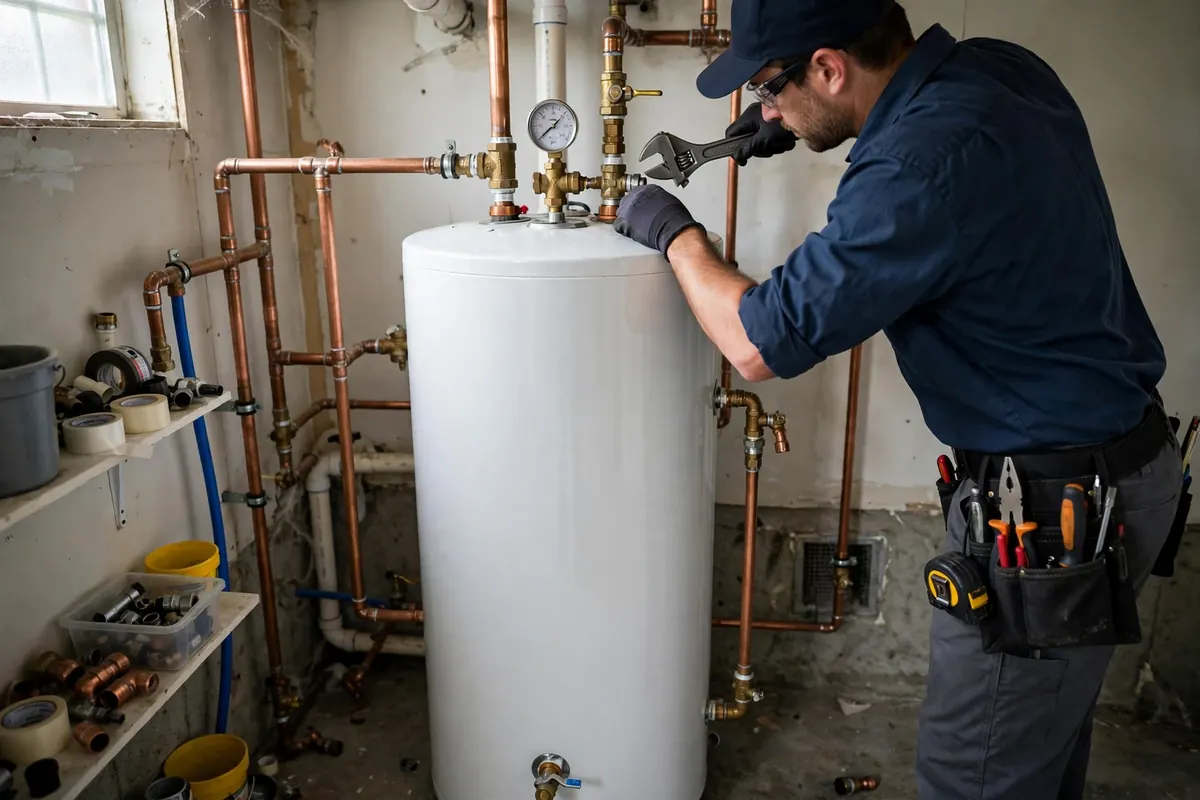
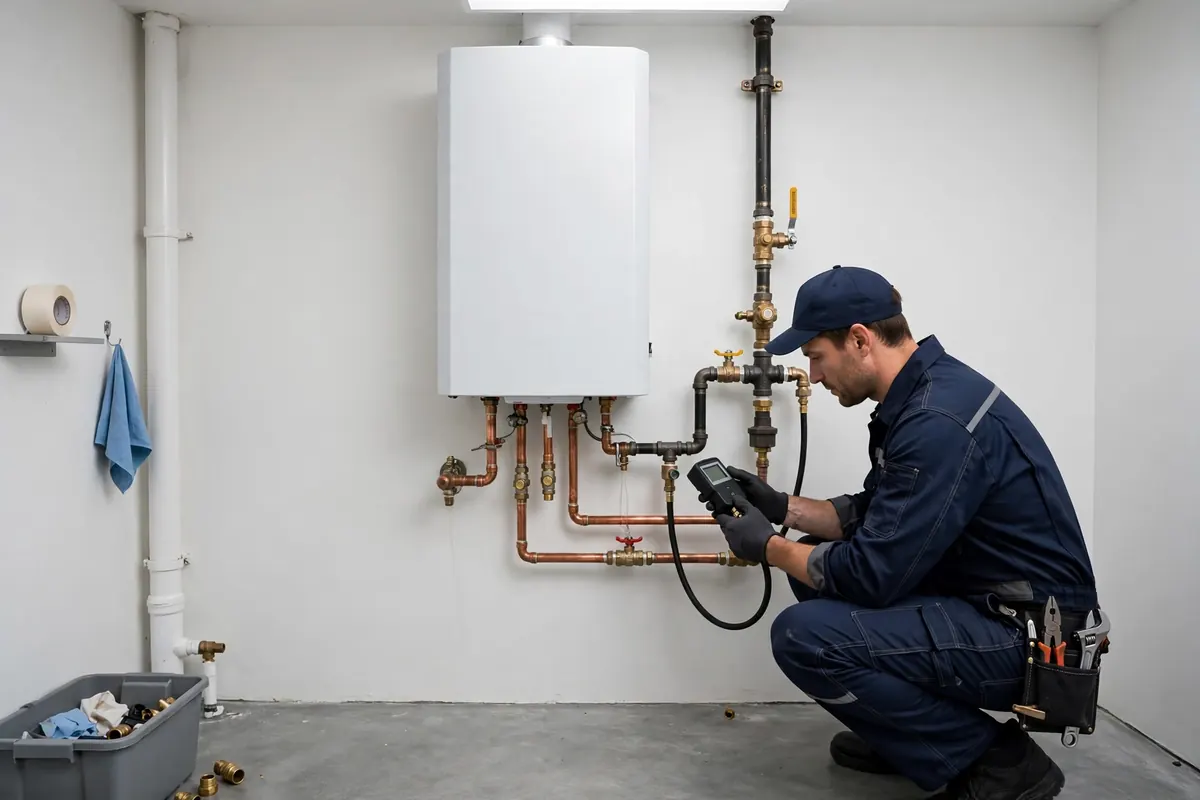
- Water heater leak isolation and replacement
- Main water line break repair
- Frozen pipe thawing and split-pipe repair
- Fixture overflow and toilet overflow control
Your options
Emergency repair now, permanent work next
Some emergencies are fixed in one visit. Others need a temporary repair that stops the water today and a planned permanent repair once the full extent is known — a lateral that needs excavation, for example, or a heater that needs a specific replacement. Both are part of the same job.
Same-day repair for a single failure
A split section of accessible pipe, a failed supply hose, a burst trap or a leaking fitting is usually a same-day repair. The work is a section replacement with the right material for the existing system, not a patch that fails at the next freeze.
Camera diagnosis for a hidden failure
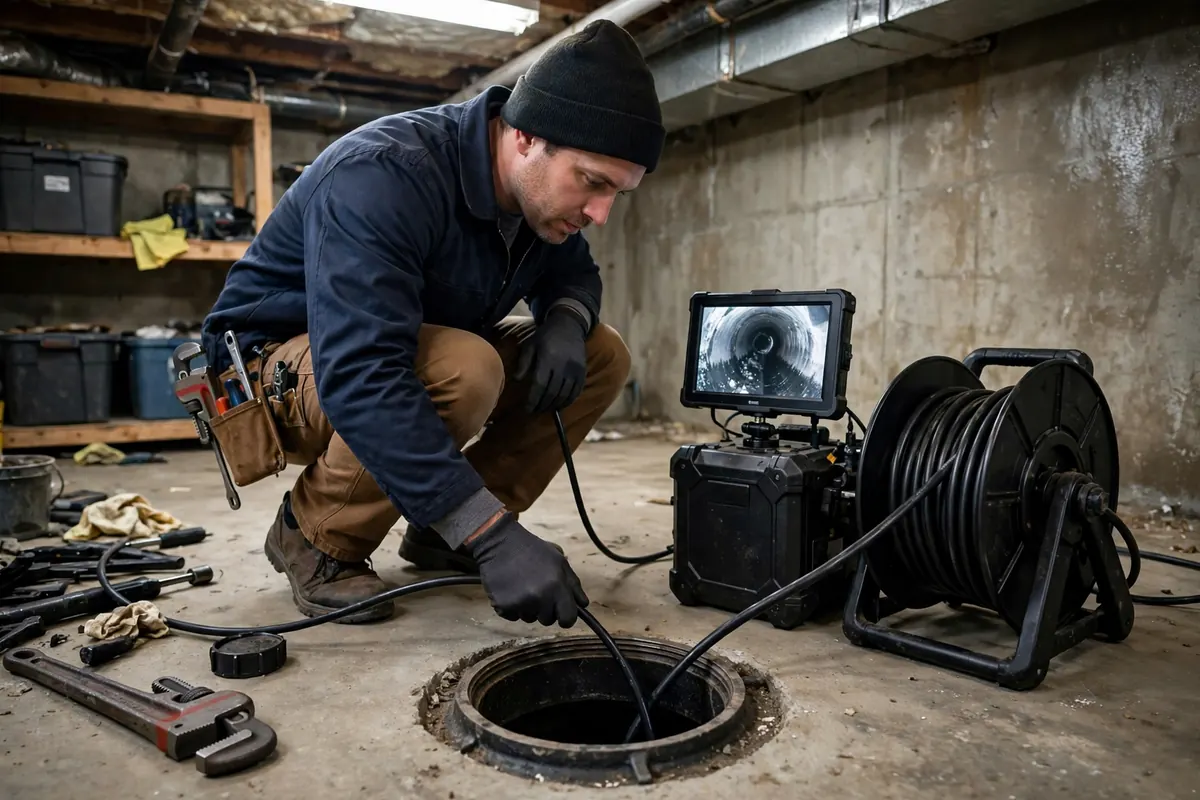
When the failure is underground or inside a slab, a sewer camera or a leak-detection visit finds the exact point before any digging starts. The camera page on this site explains how that inspection works and what it shows.
Repair or replace?
The repair-or-replace question in an emergency is answered by the age and condition of the failed part, not by the size of the leak. A ten-year-old copper line with a single freeze split is a repair: cut out the split section, replace it, insulate the run. A galvanized line that has corroded through in one place has the same corrosion through its whole length, and replacing one section only moves the next failure a few feet down the line.
Water heaters follow the same logic. A failed fitting or a relief valve is a repair. A tank that is leaking through its wall is a replacement, because a tank wall cannot be patched from the inside. Sewer laterals are the hardest call: a single root intrusion can be cleared, but a collapsed clay section or a line with multiple offsets is a repair that keeps returning until the damaged section is replaced. The sewer line repair page walks through that decision in detail.
Can I do this myself?
There are two things a homeowner should do before a professional arrives: shut off the water and, if water is near outlets or the electrical panel, stay out of the room and call for help. Everything after that is judgment about where the failure is and what the system will tolerate. Thawing a frozen pipe with a torch or an open flame is how houses catch fire; a hair dryer on low, aimed at the frozen section with the tap open, is the safe version, and even that only helps if the pipe has not already split.
Chemical drain openers do not belong in an emergency. They do not clear a sewer backup, they can damage older pipes, and they turn a plumber's job into a chemical exposure. A plunger on a single clogged toilet is fine. A backup that appears in more than one fixture is a main-line problem and it needs equipment, not a bottle.
Plumbing in Harrisburg: the local picture
Harrisburg's emergency pattern follows its housing and its river. The oldest stock sits in Midtown, Uptown, Allison Hill and Shipoke, where galvanized supply lines and clay laterals are the norm and where a freeze hits exterior-wall plumbing in rowhomes that were built before modern insulation. Shipoke sits entirely in the Susquehanna floodplain and has taken river water in 1972, 2004 and 2011, so basements and low pipe runs there have a long history of being soaked. Spring thaw adds a second wave: melting snow and ice overwhelm drainage, and a sump pump that has sat idle all winter is asked to work at full capacity on the first warm weekend.
The metro spreads the same risks across different housing. Mechanicsburg and Camp Hill have post-war ranches and split-levels with utility-room plumbing and long exterior runs. Hershey's housing ranges from early twentieth-century homes near the factory to newer subdivisions. Carlisle's older borough homes sit on the same clay-lateral era as Harrisburg's. The common thread is age plus freeze-thaw: a pipe that survived last winter is not proof it will survive this one, because corrosion and freeze stress accumulate year after year.
One local fact shapes every emergency in the city itself. Inside the City of Harrisburg, pipe installation or replacement needs a permit, and the work must be done by a city-registered master plumber. Capital Region Water owns the mains; the homeowner owns the service line from the main to the house and the sewer lateral to the main. Knowing who owns which side of the line matters when a break is at the street, because the repair responsibility changes at the property line.
Mistakes to avoid
- Waiting to see if it stops: A leak that slows when the tap is off has not fixed itself; it has only paused. Water inside a wall keeps spreading through drywall and framing, and a stain that looks dry on the surface is often wet behind it.
- Thawing a pipe before checking for a split: A frozen pipe that has already split starts leaking the moment it thaws. Look for a split before applying heat, keep the tap open so pressure has somewhere to go, and shut the main off first if you are unsure.
- Using every drain during a backup: Running water anywhere in the house during a sewer backup adds to the water coming up through the lowest fixture. Stop using water, including laundry and dishwashers, until the line is clear.
- Pouring chemicals into a backed-up drain: Chemical openers do not clear a main-line blockage, and they sit in the standing water. They damage older pipe and make the professional's work hazardous.
- Ignoring the second freeze point: A house that froze in one place has the same exposure in every similar run. Insulating only the pipe that burst leaves the next one exposed to the same night.
What to have ready before you call
- Know where the main shutoff is before winter — basement front wall near the meter in most city homes
- Keep the street address and a description of where the water is showing ready for the call
- Move valuables, rugs and electronics out of the water path if it is safe to do so
- Note whether the water is clean, discoloured, or sewage, and whether any tap still runs
- If water is near outlets or the panel, do not step into it — call from a dry room
- Take photos of the damage for your own records before cleanup starts
What shapes the scope of the work
Emergency work varies with the time of the call, the access to the failure, and the material involved. A split section of exposed copper in a basement is a different job from a lateral break under a driveway, and a Sunday-night call carries different scheduling than a weekday one. The factors that shape the scope are access, the age and material of the system, whether excavation or wall opening is needed, and whether the repair is a section replacement or a full run. The professional talks through what the visit covers before the work starts, and the scope is set by what the failure actually is, not by a figure quoted before anyone has seen it.
How to choose a provider
An emergency call is the worst time to choose a provider from scratch, which is why the questions matter before the water is running. Ask whether the professional serves your neighbourhood, whether the visit covers diagnosis as well as repair, and what the first step will be when they arrive. A clear answer to those three questions is worth more than any slogan. The provider should be able to explain the shutoff, the diagnostic step, and the repair in plain language, and should be willing to say when a temporary repair plus a planned permanent repair is the honest sequence rather than promising a one-visit fix for a lateral that needs excavation.
Other plumbing services
Questions, answered
What should I do first if a pipe bursts in my Harrisburg home?
Shut off the main water valve first. In most Harrisburg rowhomes and older borough houses it is in the basement on the front wall, where the water service enters from the street, close to the meter. Then call. Shutting the main stops the damage from growing while help is on the way.
Is a sewer backup a plumbing emergency?
Yes. Sewage coming up through a basement floor drain, tub or shower is a health hazard. Stop using water anywhere in the house, keep people and pets out of the affected room, and call. A single gurgling drain can be a vent issue, but sewage in a fixture is a backup.
Why do Harrisburg pipes burst in winter?
Harrisburg sees around 101 nights a year at or below freezing. Water expands by about nine percent when it freezes, and the pressure splits copper, PEX and galvanized steel. The split often shows up as a leak the next morning, when the pipe thaws.
What counts as a plumbing emergency and what can wait?
Water actively damaging the home, sewage in a fixture, no water at any tap, a major leak, and a gas smell near a gas line are emergencies. A dripping faucet, a slow drain, or a running toilet can wait for a routine visit.
Do I need a permit for emergency pipe work in Harrisburg?
Inside the City of Harrisburg, pipe installation or replacement needs a permit and the work must be done by a city-registered master plumber. The Bureau of Codes handles permits. Emergency work to stop water is done first; the permit question is handled as part of the permanent repair.
Who owns the water service line in Harrisburg?
Capital Region Water owns the mains. The homeowner owns the service line from the main to the house, and the sewer lateral from the house to the main. That ownership line matters when a break is near the street.
My taps run dry after a hard freeze. Is a pipe frozen?
Often, yes. A tap that gives only a trickle, or nothing, during a cold snap usually means a frozen line. Look for a split before thawing anything, because a burst line starts leaking as it warms.
What if water is near my electrical panel?
Stay out of the room and do not step into standing water near outlets or the panel. Call from a dry room. Water and electricity together are a safety issue, not a plumbing inconvenience.
Need emergency plumber? Call Now.
Talk with a local plumbing professional about your home. Hours: Mon–Fri 7:00 AM–10:00 PM ET · Sat 8:00 AM–10:00 PM ET · Sun 7:00 AM–9:00 PM ET.
Call NowGet in touch
Call Now from any page and you will be connected with a local plumbing professional serving Harrisburg and the surrounding metro. You can also reach us by email at hello@harrisburgplumbingpros.com.
Hours: Mon–Fri 7:00 AM–10:00 PM ET · Sat 8:00 AM–10:00 PM ET · Sun 7:00 AM–9:00 PM ET.
Call Now