Home › Problems › Clogged Drains
Problems · Harrisburg, PAClogged Drains in Harrisburg, PA
Harrisburg drains clog for reasons written into the city's housing and its trees. The median home was built in 1947, and the drains inside it are cast iron and clay tile with rough interior walls that catch grease, soap and debris. The city's mature maples and oaks send roots into the joints of clay
Talk with a local plumbing professional
Hours: Mon–Fri 7:00 AM–10:00 PM ET · Sat 8:00 AM–10:00 PM ET · Sun 7:00 AM–9:00 PM ET
Call NowWhy Harrisburg drains clog
Harrisburg drains clog for reasons written into the city's housing and its trees. The median home was built in 1947, and the drains inside it are cast iron and clay tile with rough interior walls that catch grease, soap and debris. The city's mature maples and oaks send roots into the joints of clay laterals, where they grow into a mat that catches everything passing through. A drain that was cleared a year ago and is slow again is rarely a new clog; it is the same line telling you the cause was never removed. The household adds its own causes: hair in the bathroom, grease in the kitchen, and wipes that do not break down the way toilet paper does.
The difference between a clog and a blockage matters. A clog is material inside a sound pipe: hair, grease, soap, a flushed wipe. A blockage that keeps returning is usually a pipe problem wearing a clog's clothes — roots in a clay lateral, a bellied section that holds water, a broken joint that catches paper. Clearing the first is a simple job. Clearing the second without finding the cause is a bill that repeats. The drain cleaning page explains the difference between clearing and cleaning, and the sewer camera inspection page explains how the cause is found.
What clogs which drain
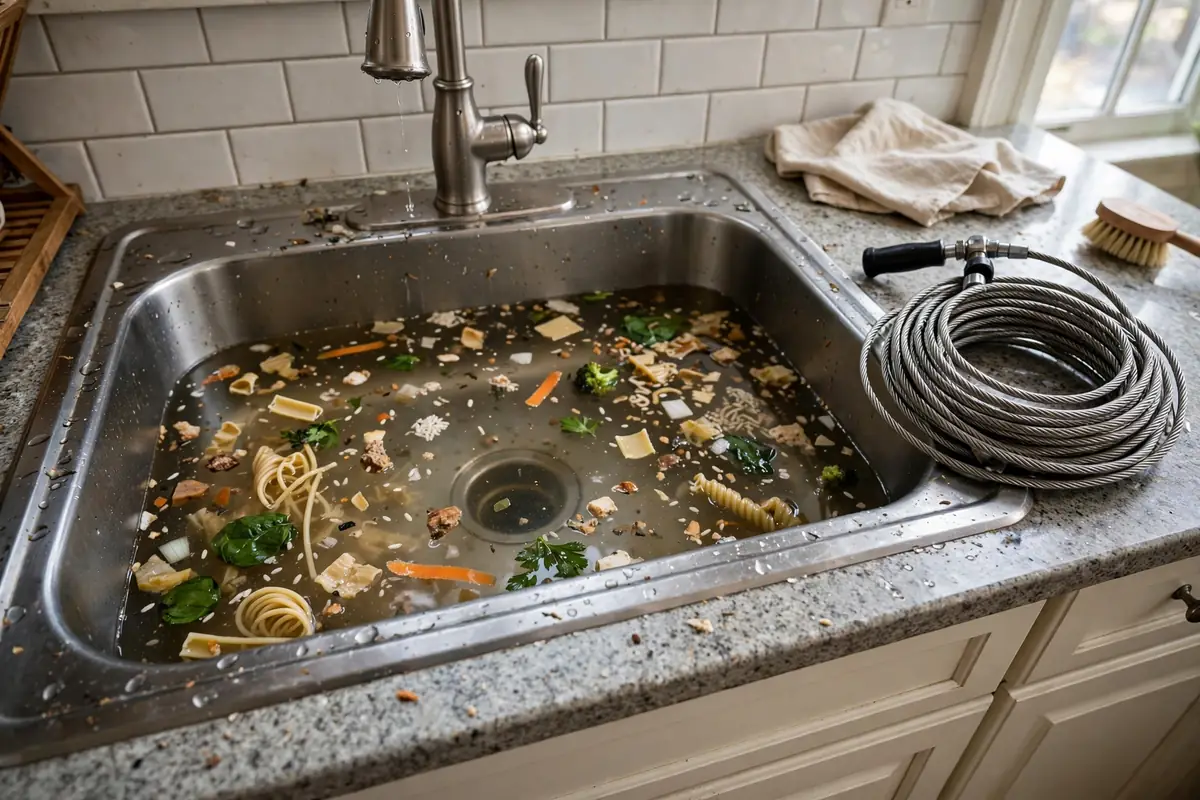
Bathroom drains clog on hair and soap scum. Hair wraps around the stopper mechanism and the trap, and soap scum coats the pipe wall and grabs the hair. Kitchen drains clog on grease: grease poured down the sink coats the inside of the pipe and hardens as it cools, and in older cast-iron pipe the rough interior grabs it, so the layer grows with every wash. Toilets clog on paper, flushed objects, and wipes — wipes labelled as flushable do not break down the way toilet paper does, and they are a leading cause of main-line blockages. Main lines clog on roots, grease, and wipes together: a root mat inside a clay lateral catches paper and waste, and the blockage grows from the mat outward. A drain that clogs in the same place, after being cleared, has a cause inside the pipe, and the camera is what finds it.
Clearing, cleaning, and preventing the next clog
Clearing opens a hole through a blockage so water passes again. Cleaning removes the buildup from the pipe wall so the drain stays open. A drain that has only been cleared will clog again sooner, because the rough buildup that caught the clog is still there. The tool is chosen by the pipe and the blockage: a hand auger for a fixture trap, a drum machine for a branch line, a hydro-jet for a grease-heavy kitchen line or a root mat in a lateral. After clearing, the line is run at full flow from several fixtures at once — a drain that clears under a trickle and backs up under a full load still has a partial blockage, and the test is what proves the job is done.
Prevention is mostly about what goes down the drain. Grease goes in a container in the bin, not down the sink. Wipes, paper towels, feminine products, cotton swabs and dental floss go in the bin, not the toilet. Hair is caught before it reaches the trap. And a drain that starts slowing is a call before it becomes a backup — the early call is a clearing, and the late call is an emergency.
The seasonal cycle of clogs
Drain clogs in Harrisburg follow a seasonal cycle, and the cycle is written into the trees and the weather. In the autumn, leaves and the first cold nights slow the drains. In the winter, grease hardens faster in the cold pipes, and the kitchen drain narrows a little more with every wash. In the spring, the thaw and the rain raise the water table, and a lateral with a partial root blockage that coped all winter backs up on the first heavy rain. In the summer, the trees are growing, and the roots in the clay laterals are growing with them — a root mat that was a partial blockage in the spring is a full blockage by the autumn.
The cycle is why a drain that is cleared in the spring clogs again in the autumn, and why a drain that is cleared without a camera look is a bill that repeats. The camera inspection breaks the cycle: it shows the roots, the break, the belly, and the buildup, and the repair or the cleaning is chosen from what the camera shows rather than from the season. The drain cleaning page explains the difference between clearing and cleaning, and the sewer camera inspection page explains the diagnostic step.
Talk with a local plumbing professional
Hours: Mon–Fri 7:00 AM–10:00 PM ET · Sat 8:00 AM–10:00 PM ET · Sun 7:00 AM–9:00 PM ET
Call NowQuestions, answered
Why does the same drain clog every few weeks?
Because the cause is inside the pipe — a root intrusion, a bellied section, a broken joint, or heavy buildup. Each clearing without a camera look is money spent on the symptom while the cause grows.
Do wipes labelled flushable actually break down?
No. Independent testing has shown that wipes marketed as flushable stay intact in water far longer than toilet paper. In a Harrisburg home with a clay lateral, they catch on the joints and the root mat and start a blockage.
Clearing or cleaning — which does my drain need?
Clearing opens a hole through a blockage so water passes again. Cleaning removes the buildup from the pipe wall so the drain stays open. A line that has only been cleared will clog again sooner, because the buildup that caught the clog is still there.
What should I use instead of chemical drain cleaner?
A plunger for a single fixture, and a mechanical clearing for anything past the trap. Chemicals cannot reach a main-line blockage, and they make the professional's work hazardous without fixing the cause.
Need help with clogged drains? Call Now.
Talk with a local plumbing professional about your home. Hours: Mon–Fri 7:00 AM–10:00 PM ET · Sat 8:00 AM–10:00 PM ET · Sun 7:00 AM–9:00 PM ET.
Call NowGet in touch
Call Now from any page and you will be connected with a local plumbing professional serving Harrisburg and the surrounding metro. You can also reach us by email at hello@harrisburgplumbingpros.com.
Hours: Mon–Fri 7:00 AM–10:00 PM ET · Sat 8:00 AM–10:00 PM ET · Sun 7:00 AM–9:00 PM ET.
Call Now