Home › Services › Trenchless Sewer Repair
Services · Harrisburg, PATrenchless Sewer Repair in Harrisburg, PA
Trenchless sewer repair fixes a damaged lateral without digging a trench across the yard. A new pipe is formed inside the old one — a liner saturated with resin is inserted into the lateral, inflated against the old pipe wall, and cured in place, leaving a smooth, jointless pipe inside the original.
Talk with a local plumbing professional
Hours: Mon–Fri 7:00 AM–10:00 PM ET · Sat 8:00 AM–10:00 PM ET · Sun 7:00 AM–9:00 PM ET
Call NowWhat trenchless sewer repair is
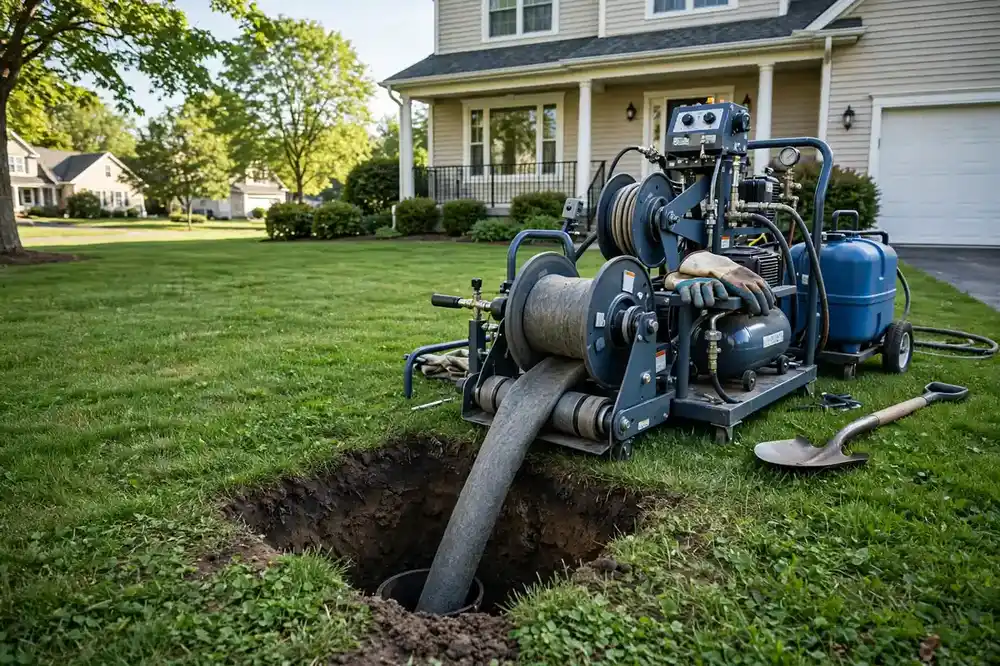
Trenchless sewer repair fixes a damaged lateral without digging a trench across the yard. A new pipe is formed inside the old one — a liner saturated with resin is inserted into the lateral, inflated against the old pipe wall, and cured in place, leaving a smooth, jointless pipe inside the original. The old pipe becomes a host for the new one, and the yard, the driveway and the walkway stay where they are. The work is done from two small access points, usually a cleanout and the connection at the main, rather than from an open trench.
The method suits Harrisburg's laterals particularly well, because the most common failures here are the ones a liner fixes: cracked clay tile, joints opened by roots, and separated joints that leak. A liner seals every joint along its length in a single run, so the roots that entered through the joints have nowhere to enter again. What a liner cannot fix is a pipe that has collapsed completely, a pipe that has lost its shape so badly it cannot host a liner, or a pipe that has settled into a belly so deep that the liner would follow the belly. Those cases need excavation, and the camera inspection is what tells the two apart before any work starts.
When trenchless fits and when it does not
Trenchless fits a lateral that is still round enough to host a liner, where the damage is cracking, joint failure and root intrusion rather than a full collapse. It fits a lateral that runs under a driveway, a patio, a mature tree, or a finished walkway — anywhere excavation would be expensive or destructive. It fits a long run of damaged pipe, where a spot repair would fix one failure and leave the next one in place. And it fits a homeowner who wants the repair done without the yard being dug up and restored over the following season.
It does not fit a collapsed section, because the liner has nothing to hold its shape against. It does not fit a belly so deep that the liner would hold water in the same low spot — the shape of the pipe is the problem, not the wall, and a liner follows the shape. It does not fit a lateral that has been displaced so far that the sections no longer line up. In those cases the repair is excavation: a spot repair of the collapsed section, or a full replacement. The camera record is what decides, and a provider who recommends trenchless without a camera record has skipped the diagnostic step.
How the work is done
The work starts with a camera inspection, because the liner must be sized and planned from the actual pipe: its material, its diameter, the length of the damaged run, and the location of the connections. The lateral is then cleaned — roots cut, grease jetted, debris removed — so the liner bonds to a clean pipe wall rather than to a layer of buildup. The liner is measured, saturated with resin, inserted into the lateral from the access point, and inflated against the old pipe wall. It is cured in place, usually with hot water or steam, until the resin hardens into a rigid, jointless pipe. The connections are reopened from inside the liner with a robotic cutter, the line is camera-checked again, and the flow is tested at full load.
The whole sequence is usually completed in a day, and the surface restoration is limited to the two small access points rather than a trench across the yard. The cured liner is a structural pipe in its own right, smooth on the inside so waste flows freely, and sealed at every joint so roots cannot re-enter. The sewer line repair page explains the other repair options, and the sewer camera inspection page explains the diagnostic step that precedes any of them.
What a liner changes for the homeowner
The most visible change is the absence of a trench. A traditional lateral replacement digs up the front yard from the house to the street, and the restoration — the lawn, the walkway, the driveway section — takes a season to settle. A trenchless repair leaves the surface intact, which matters most where the lateral runs under a paved driveway, a mature tree, or a front walk that would be expensive to rebuild. The second change is the jointless interior: a clay lateral has a joint every few feet, and each joint is an opening for roots. A liner has no joints, so the root problem is removed along the whole lined length rather than at one repaired joint.
The third change is time. A lined lateral is back in service the same day, and the flow test at the end of the visit proves the repair before the crew leaves. The liner's smooth interior also improves flow compared with a scaled cast-iron or rough clay pipe, which is why a lateral that was slow before the repair often drains better after it. None of this makes trenchless the right answer for every lateral — a collapsed pipe still needs excavation — but where it fits, it is the repair that does the most with the least disruption.
Talk with a local plumbing professional
Hours: Mon–Fri 7:00 AM–10:00 PM ET · Sat 8:00 AM–10:00 PM ET · Sun 7:00 AM–9:00 PM ET
Call NowQuestions, answered
How does trenchless repair avoid digging?
A resin-saturated liner is inserted into the lateral, inflated against the old pipe wall, and cured in place — a new jointless pipe inside the old one. The work is done from two small access points, so the yard, driveway and walkway stay intact.
When does trenchless not work?
When the pipe has collapsed completely, when it has lost its shape so badly it cannot host a liner, or when a deep belly means the liner would hold water in the same low spot. Those cases need excavation.
How long does a trenchless repair take?
Usually a day, from camera inspection and cleaning through lining, curing and the final camera check. The lateral is back in service the same day.
Will roots come back after a trenchless repair?
No, along the lined length. A liner is jointless, and roots enter through joints — so the lined section has no openings for roots to enter through.
Do I need a camera inspection before trenchless repair?
Yes. The liner is sized and planned from the camera record — the pipe material, diameter, length of damage, and the location of connections. A trenchless repair recommended without one is a guess.
Does trenchless work on clay tile laterals?
Yes. Clay tile with cracked joints and root intrusion is the most common trenchless candidate in Harrisburg, because the liner seals every joint along its length in a single run.
Need help with trenchless sewer repair? Call Now.
Talk with a local plumbing professional about your home. Hours: Mon–Fri 7:00 AM–10:00 PM ET · Sat 8:00 AM–10:00 PM ET · Sun 7:00 AM–9:00 PM ET.
Call NowGet in touch
Call Now from any page and you will be connected with a local plumbing professional serving Harrisburg and the surrounding metro. You can also reach us by email at hello@harrisburgplumbingpros.com.
Hours: Mon–Fri 7:00 AM–10:00 PM ET · Sat 8:00 AM–10:00 PM ET · Sun 7:00 AM–9:00 PM ET.
Call Now