Home › Blog › How Long Does a Water Heater Last?
Guide · Harrisburg, PAHow Long Does a Water Heater Last?
A water heater does not come with a countdown timer, but it does come with a service life — and in Harrisburg, that life is shaped by the water, the basement it sits in, and whether anyone has ever serviced it. This guide answers the question every homeowner asks when the shower goes cold or the tan
Talk with a local plumbing professional
Hours: Mon–Fri 7:00 AM–10:00 PM ET · Sat 8:00 AM–10:00 PM ET · Sun 7:00 AM–9:00 PM ET
Call NowPublished 2026-11-17 · Harrisburg Plumbing Pros · Harrisburg, PA
A water heater does not come with a countdown timer, but it does come with a service life — and in Harrisburg, that life is shaped by the water, the basement it sits in, and whether anyone has ever serviced it. This guide answers the question every homeowner asks when the shower goes cold or the tank starts rumbling: how long does a water heater last, how do I know mine is failing, and when is it time to repair it versus replace it? The answers are local, because the water and the winters here are local too.
The short version
A tank water heater's service life is usually given as eight to twelve years, and a tankless unit's as fifteen to twenty — but those figures are averages, and the range around them is wide. A tank that is flushed annually, whose anode rod is replaced when it is consumed, and whose relief valve is tested will serve at the top of its range and beyond. A tank that has never been flushed, in a damp ba
The service life: what the numbers mean
A tank water heater's service life is usually given as eight to twelve years, and a tankless unit's as fifteen to twenty — but those figures are averages, and the range around them is wide. A tank that is flushed annually, whose anode rod is replaced when it is consumed, and whose relief valve is tested will serve at the top of its range and beyond. A tank that has never been flushed, in a damp basement, fed by central Pennsylvania water that leaves sediment behind, will fail at the bottom of its range — or before it. The service life is not a date on the label; it is the result of the maintenance the heater has received and the water it has carried.
The age on the label is the starting point, not the verdict. A heater under ten years old with a failed element or thermostat is a repair — the tank has years of service left and the part is replaceable. A heater over twelve years old with rust-coloured water, a depleted anode rod and a rumbling tank is a replacement waiting to happen, and repairing one part only delays the tank failure by months. The bright line is the tank wall: a leak through the wall is a replacement, full stop, because a steel tank cannot be patched from the inside. The water heater repair page explains the repairs, and the water heater replacement page explains the replacement.
What shortens a Harrisburg heater's life
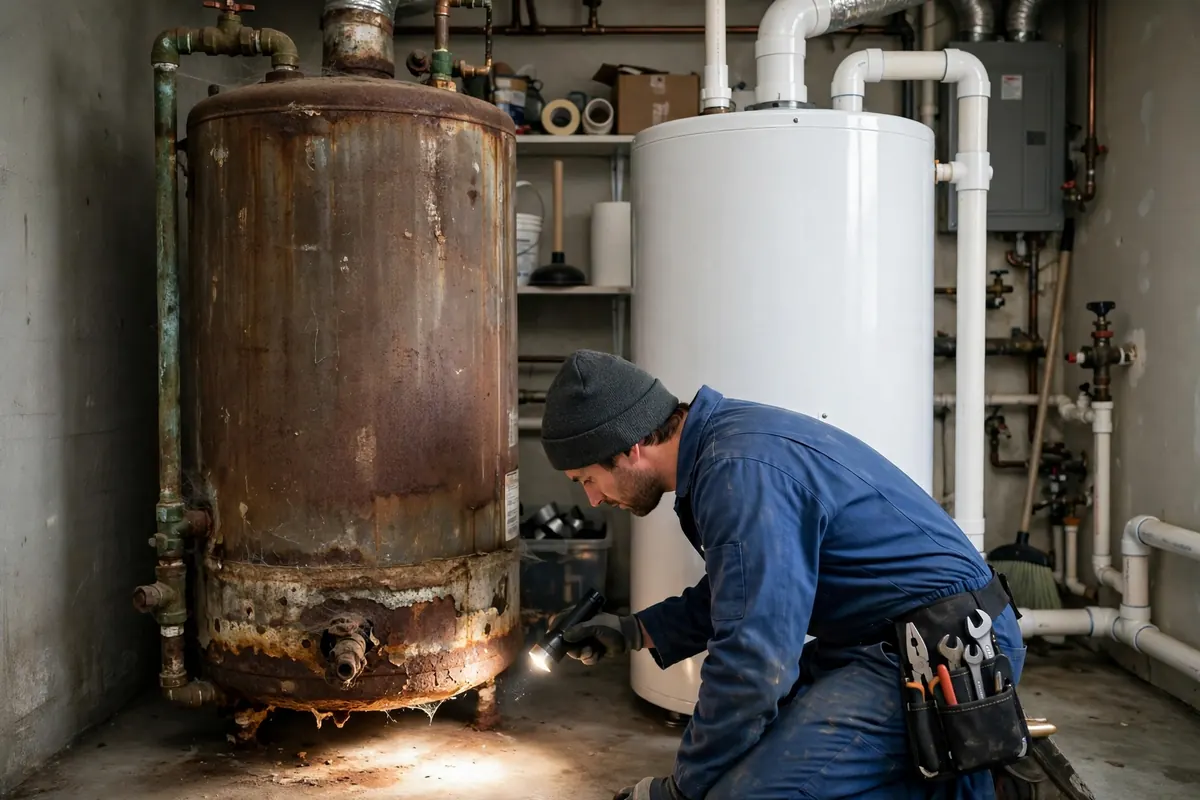
Sediment is the first shortener. Central Pennsylvania water leaves mineral sediment in the tank, and the sediment settles on the bottom where it insulates the water from the heat source. The heater runs longer, uses more energy, and the bottom of the tank overheats. A tank that is never flushed accumulates sediment year after year, and the popping or rumbling sound from the tank is the sediment announcing itself. The second shortener is the anode rod. The rod is a magnesium or aluminium rod inside the tank that corrodes so the steel does not have to, and once the rod is consumed, the tank wall starts corroding. Most rods last several years, and a heater that has never had its rod checked is running unprotected.
The third shortener is the basement itself. Many Harrisburg heaters sit in basements of homes built in the 1940s and 1950s, where the heater shares space with an old boiler or furnace and where the venting and gas lines are as old as the house. A heater in a damp Shipoke basement, where the floodplain has taken river water in 1972, 2004 and 2011, faces corrosion from the outside as well as the inside. And the winters add a fourth: the incoming cold water is colder, so the heater works longer to bring it to temperature, and the freeze-thaw season puts the heater's own pipes at risk in unheated utility rooms and basements.
The signs your heater is failing
The signs arrive in order, and the order matters. Rust-coloured water only in the hot taps is the first: it points to corrosion inside the tank or a depleted anode rod, and it is the warning before the leak. Hot water that runs out too fast is the second: a broken dip tube letting cold water mix at the top of the tank, a failed lower element leaving half the tank unheated, or sediment displacing water in the tank. Popping, rumbling or banging from the tank is the third: sediment on the bottom trapping water beneath it, flashing to steam. Water pooling around the base is the fourth, and it is the one that decides the question: a fitting leak is a repair, and a tank leak — water seeping from the tank wall or the base seam — means the tank has failed. A relief valve that discharges water is the fifth: it is responding to pressure or temperature it should not be seeing, and it can mean a failed thermostat or a valve that has failed open.
Each sign has a different urgency, and the urgency is set by the tank wall. A noisy heater is a service call. Rust-coloured water is a call while the tank is still holding water. A tank leak is a replacement, and the water it releases goes onto the floor. The water heater repair page walks through each symptom and its cause, and the leak detection page explains how a hidden leak is found when the water is not visible.
Maintenance that adds years
The maintenance that adds years to a heater is simple, and it is the maintenance that is most often skipped. An annual flush removes the sediment that central Pennsylvania water leaves behind — the tank is drained, the sediment is washed out, and the flow is restored. The anode rod is checked on schedule and replaced when it is consumed, so the tank wall stays protected. The relief valve is tested, the temperature is set to a safe level, and the area around the heater is kept clear so the burner or the elements can be serviced. A heater that is flushed annually and whose anode rod is replaced when it is consumed will serve for its full expected life; a heater that is never flushed will lose capacity, run louder, and fail earlier. The maintenance is simple, and it is the difference between a heater that lasts and a heater that is replaced early.
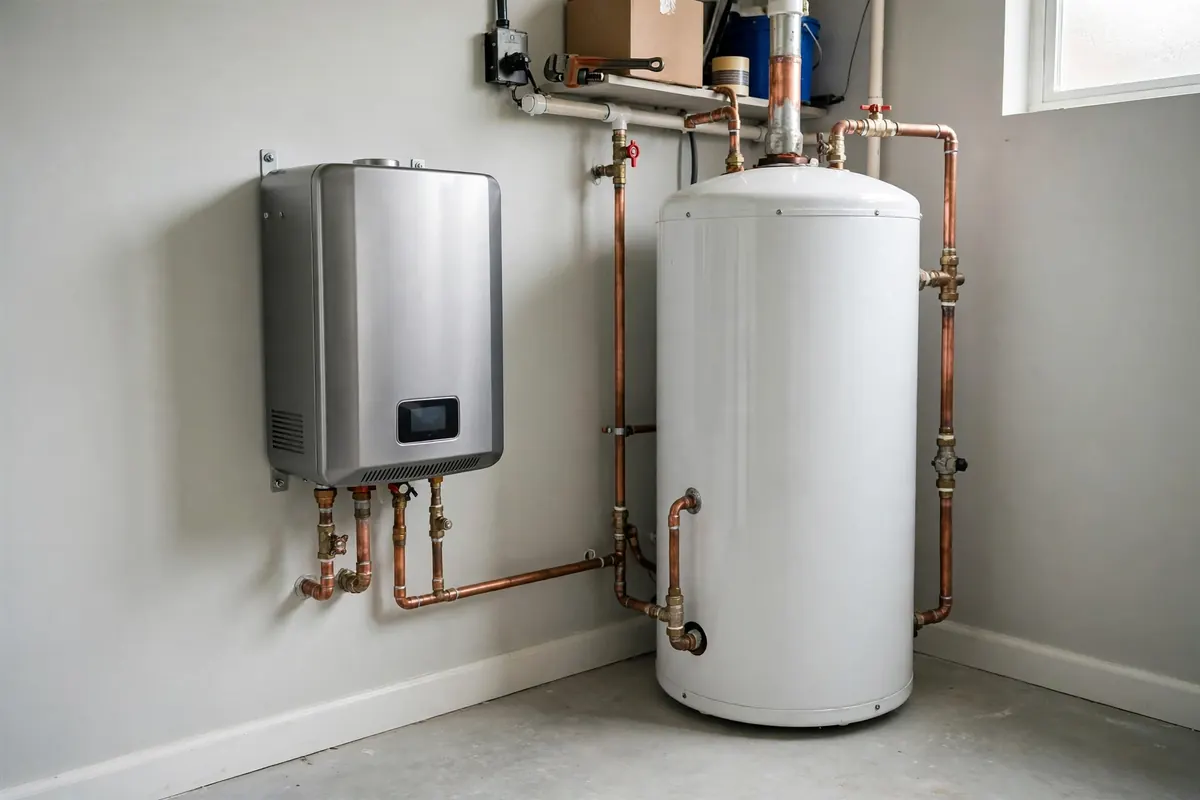
For a tankless unit, the maintenance is descaling. Central Pennsylvania water leaves scale in the heat exchanger, and scale narrows the passages, reduces flow, and can trigger error shutdowns. A tankless unit that is never descaled loses flow and shuts down on error, and the schedule depends on the water hardness in the home. The tankless water heater installation page explains the descaling schedule and the water treatment that protects the exchanger.
Repair or replace: the decision
The decision is made from the age and the tank wall, not from the size of the symptom. A heater under ten years old with a failed element, thermostat, dip tube or relief valve is a repair — the tank has years left and the part is replaceable. A heater over twelve years old with rust-coloured water and a rumbling tank is a replacement waiting to happen. A tank leaking through its wall is always a replacement. The replacement is also the moment to fix the sizing: a household that has grown since the heater was installed may have outgrown a forty-gallon tank, and the new heater is sized to the household as it stands today. The tankless option suits a household that runs out of hot water and a home with the gas capacity to support it; a new tank suits modest demand and the simplest replacement. The tankless versus tank guide in the blog compares the two in detail.
Key takeaways
A tank lasts eight to twelve years, a tankless unit fifteen to twenty — and the range is set by maintenance, not by the label. An annual flush and an anode rod replaced on schedule are the two habits that add years, and a heater that is never flushed will lose capacity, run louder, and fail earlier than a heater that is serviced. The temperature setting matters too: set it to a safe level, test the relief valve, and keep the area around the heater clear so the burner or the elements can be serviced when the time comes. The signs arrive in order: rust-coloured hot water, hot water that runs out too fast, a rumbling tank, and then water at the base. The tank wall decides the repair-or-replace question, and a leak through the wall is always a replacement.
Talk with a local plumbing professional
Hours: Mon–Fri 7:00 AM–10:00 PM ET · Sat 8:00 AM–10:00 PM ET · Sun 7:00 AM–9:00 PM ET
Call Now
Questions, answered
How long does a tank water heater last?
Usually eight to twelve years, depending on maintenance and water quality. A tank flushed annually with its anode rod replaced on schedule serves at the top of its range; a tank never flushed fails at the bottom.
How long does a tankless water heater last?
Usually fifteen to twenty years, with regular descaling. Central Pennsylvania water leaves scale in the heat exchanger, so descaling is part of owning the unit.
What is the first sign a water heater is failing?
Rust-coloured water only in the hot taps. It points to corrosion inside the tank or a depleted anode rod, and it is the warning before a tank leak.
Is a leaking water heater always a replacement?
Not always. A leak from a fitting or a relief valve can be repaired. A leak through the tank wall cannot — the tank has failed and needs replacement. The location of the leak decides, and the visit starts by finding it.
How often does a Harrisburg water heater need flushing?
Once a year. Central Pennsylvania water leaves mineral sediment behind, and a tank that is never flushed loses capacity, runs louder, and fails earlier. The first flush on a neglected tank releases a surprising amount of sediment.
How do I decide between repairing and replacing a heater?
By the age and the tank wall. A heater under ten years old with a failed part is a repair. A heater over twelve years old with rust-coloured water and a rumbling tank is a replacement waiting to happen. A tank leaking through its wall is always a replacement.
Questions about your plumbing? Call Now.
Talk with a local plumbing professional about your home. Hours: Mon–Fri 7:00 AM–10:00 PM ET · Sat 8:00 AM–10:00 PM ET · Sun 7:00 AM–9:00 PM ET.
Call NowGet in touch
Call Now from any page and you will be connected with a local plumbing professional serving Harrisburg and the surrounding metro. You can also reach us by email at hello@harrisburgplumbingpros.com.
Hours: Mon–Fri 7:00 AM–10:00 PM ET · Sat 8:00 AM–10:00 PM ET · Sun 7:00 AM–9:00 PM ET.
Call Now