Home › Blog › Tankless vs Tank Water Heater: Which Is Right for Your Harrisburg Home?
Guide · Harrisburg, PATankless vs Tank Water Heater: Which Is Right for Your Harrisburg Home?
Every water heater replacement in Harrisburg eventually reaches the same question: another tank, or a switch to tankless? The two are different machines with different strengths, different failure modes, and different demands on the house — and the right answer depends on the household, the house, a
Talk with a local plumbing professional
Hours: Mon–Fri 7:00 AM–10:00 PM ET · Sat 8:00 AM–10:00 PM ET · Sun 7:00 AM–9:00 PM ET
Call NowPublished 2026-11-17 · Harrisburg Plumbing Pros · Harrisburg, PA
Every water heater replacement in Harrisburg eventually reaches the same question: another tank, or a switch to tankless? The two are different machines with different strengths, different failure modes, and different demands on the house — and the right answer depends on the household, the house, and the winter. This guide is the honest comparison, written for a Harrisburg home: how each one works, what each one costs in the ways that matter, and how the decision is made.
The short version
A tank water heater stores forty or fifty gallons of water in an insulated steel tank and keeps it at temperature around the clock, with a gas burner or electric elements. Cold water enters through a dip tube to the bottom of the tank, hot water leaves from the top, and a thermostat holds the temperature steady. A glass lining and a sacrificial anode rod protect the steel from corrosion, and a tem
How a tank heater works — and how it fails
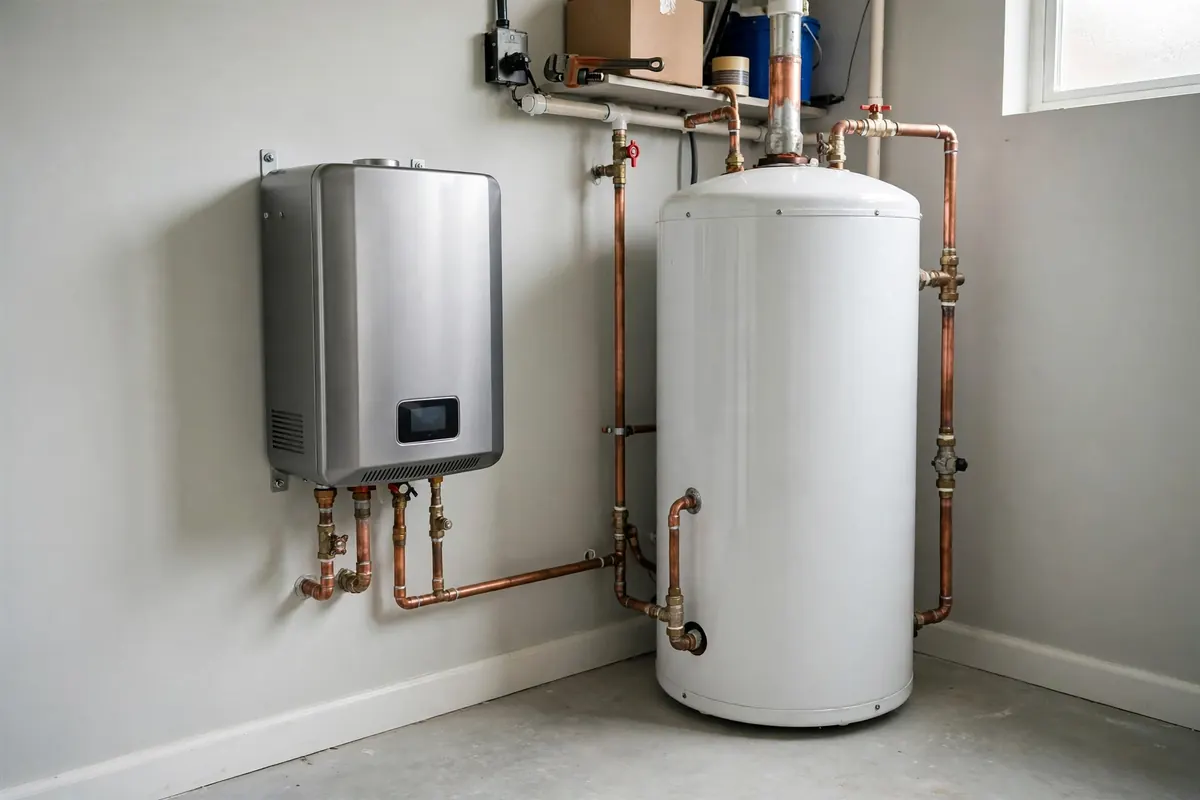
A tank water heater stores forty or fifty gallons of water in an insulated steel tank and keeps it at temperature around the clock, with a gas burner or electric elements. Cold water enters through a dip tube to the bottom of the tank, hot water leaves from the top, and a thermostat holds the temperature steady. A glass lining and a sacrificial anode rod protect the steel from corrosion, and a temperature-and-pressure relief valve protects the tank from overpressure. It is a simple machine with a hard life: the tank is constantly corroding from the inside, fed by central Pennsylvania water that leaves sediment behind, and its parts — the thermostat, the elements or burner, the dip tube, the anode rod, the relief valve — each have a service life and fail one at a time.
The tank's failure mode is the leak. A tank that is leaking through its wall has failed, and the leak only grows — forty or fifty gallons onto the floor, and the water keeps coming until the supply is shut off. The warning signs arrive first: rust-coloured water in the hot taps, a rumbling tank full of sediment, a heater over twelve years old with a depleted anode rod. A tank heater that has never been flushed, in a damp basement, is a heater whose failure arrives on the coldest morning of the year. The water heater repair page explains the repairs, and the water heater replacement page explains the replacement.
How a tankless heater works — and how it fails
A tankless water heater is a heat exchanger with a burner or electric elements, mounted on a wall. When a hot tap opens, a flow sensor starts the burner or the elements, and water passing through the exchanger is heated on its way to the tap. When the tap closes, the unit shuts down. The water is heated once, at the moment of use, and there is no stored hot water to keep warm. There is no tank to fill, no stored water cooling between uses, and no tank wall to corrode through — which means the tank's failure mode does not exist. What a tankless unit has instead is a flow rate: a maximum amount of hot water it can produce at a given temperature rise, and that flow rate is the whole sizing question.
The tankless failure mode is different: scale, and sizing. Central Pennsylvania water leaves mineral scale in the heat exchanger, and scale narrows the passages, reduces flow, and can trigger error shutdowns. A tankless unit in this region needs regular descaling and, in many homes, water treatment. And a unit sized for one shower at a time will disappoint a household that runs two showers and a dishwasher together — the most common tankless disappointment is a unit sized for one fixture serving a household that uses two or three at once. The tankless water heater installation page explains the sizing and the installation in detail.
The Harrisburg winter: the sizing question that decides it
Harrisburg's winters shape the tankless decision more than any other factor. The incoming water in January is cold, so a tankless unit must raise the temperature further than a unit in a warm climate — and that larger temperature rise reduces the flow rate the unit can deliver. A unit sized from a summer rating will disappoint in February, when the demand is highest and the water is coldest. The sizing on this site is done at the winter temperature rise, because that is when the household notices a shortfall. A tank heater does not have this problem in the same way: it stores hot water, and the cold incoming water only means a longer recovery time between draws, not a lower flow rate at the tap.
The housing stock shapes the installation. A gas tankless unit needs a larger gas line than a tank heater, because it burns more gas in a shorter time — and an older Harrisburg home with a small gas service may need a gas line upgrade before the unit can run at full capacity. Gas tankless units vent differently from tank heaters, often through the wall rather than up a chimney, and an older home's chimney may not be suitable. The unit is the easy part; the gas line, the vent route and the winter sizing are the work. The tankless installation page explains each of these.
The honest comparison
Endless hot water is the tankless advantage, and it is real: a tankless unit heats water continuously for as long as a tap is open, so it does not run out the way a tank does — within its flow rate. A household that runs out of hot water when showers follow each other, or when the washer runs during a shower, has outgrown its tank, and a tankless unit sized for the household's peak demand removes the limit entirely. Space is the second advantage: a tankless unit hangs on a wall and frees the floor space a tank occupies, which matters in a small utility room or a crowded basement. And the absence of a tank is the third: no stored water to spill, no tank wall to corrode through.
The tank's advantages are simplicity and forgiveness. A tank heater is simpler to install — it replaces the old tank in the same spot, on the same gas line and venting — and it keeps heating without power if it has a standing pilot, which matters in a winter storm. A tank heater is also more forgiving of scale: sediment shortens its life, but it does not shut the heater down on error the way scale shuts down a tankless unit. And a tank heater's sizing is simpler: gallons stored, matched to the household's peak hour, rather than a flow rate at a winter temperature rise. The tank is the simpler replacement, and for a household whose demand is modest, it is the honest answer.
Which one is right for your home
The decision is made from three inputs, and they are all about your house rather than about the technology. The first is the household's peak demand: how many showers, whether the washer and dishwasher run at the same time, whether a soaking tub is in use. A household that runs out of hot water is a tankless candidate; a household that never does is not. The second is the home's infrastructure: the gas line size, the electrical service, and the vent route. A home whose gas service cannot support a tankless unit without major work is a home where a new tank is the honest answer. The third is the maintenance the owner will actually do: a tankless unit needs regular descaling in central Pennsylvania, and an owner who will not do it will be disappointed by a unit that loses flow and shuts down on error. A tank needs an annual flush and an anode check, and an owner who will not do that will be replacing a tank early either way.
The replacement is also a moment to fix the sizing. A household that has grown since the heater was installed may have outgrown a forty-gallon tank, and the new heater — tank or tankless — is sized to the household as it stands today rather than to the household that lived there when the old one was installed. The water heater replacement page explains the sizing, and the tankless installation page explains the tankless sizing at the winter temperature rise. The right answer is the one that comes from those three inputs, not from a preference for one technology over the other.
What to ask before you decide
Ask how the unit was sized. A provider who sizes from your household's peak demand at the winter temperature rise — and who can show you the flow-rate figure that sizing produces — is working from your house rather than from a catalogue. Ask whether the gas line and the vent route have been checked, and what the descaling schedule will be for a tankless unit. Ask what size tank the household actually needs, if the answer is a tank, since a heater that is too small will always run out of hot water and a heater that is too large wastes energy keeping water hot around the clock. The provider who talks about the gas line, the venting, the scale and the sizing before talking about the unit is the one whose installation will still be delivering hot water in February.
Key takeaways
Tankless gives endless hot water within its flow rate, and no tank to leak. A tank is simpler to install, more forgiving of scale, and keeps heating without power if it has a standing pilot. The decision is made from three inputs: the household's peak demand, the home's gas line and vent route, and the maintenance the owner will actually do. And the sizing — for either one — is done at the winter temperature rise, because February is when the household notices a shortfall.
Talk with a local plumbing professional
Hours: Mon–Fri 7:00 AM–10:00 PM ET · Sat 8:00 AM–10:00 PM ET · Sun 7:00 AM–9:00 PM ET
Call NowMore from the blog
Questions, answered
Does tankless really mean never running out?
Within its flow rate, yes. A tankless unit heats water continuously for as long as a tap is open, so it does not run out the way a tank does. It can still be overwhelmed if more fixtures run at once than it was sized for.
Does tankless work when the incoming water is cold?
Yes, if it is sized for the winter temperature rise. Harrisburg's incoming water is cold in January, so the unit must raise the temperature further, which reduces its flow rate. Sizing must account for that, or the household will be short in February.
Why does tankless need a gas line upgrade?
A gas tankless unit burns more gas in a shorter time than a tank heater, so the line that fed the old tank is often too small. Installing the unit on the old line starves it at full demand, and it will not deliver its rated flow.
What maintenance does a tankless unit need in Harrisburg?
Regular descaling. Central Pennsylvania water leaves scale in the heat exchanger, and scale narrows the passages and can trigger error shutdowns. The schedule depends on the water hardness in the home, and the installer sets it up at commissioning.
Does a tankless heater work without power?
No. A tankless unit needs electricity for its controls and its flow sensor, so it stops heating during a power cut. A tank heater with a standing pilot keeps heating without power, which is a real difference in a winter storm.
Should I replace my tank heater with a tankless one?
It depends on the household's peak demand, the home's gas capacity and vent route, and whether the owner will keep up the descaling. A household that runs out of hot water is a tankless candidate; a household that never does is not.
Questions about your plumbing? Call Now.
Talk with a local plumbing professional about your home. Hours: Mon–Fri 7:00 AM–10:00 PM ET · Sat 8:00 AM–10:00 PM ET · Sun 7:00 AM–9:00 PM ET.
Call NowGet in touch
Call Now from any page and you will be connected with a local plumbing professional serving Harrisburg and the surrounding metro. You can also reach us by email at hello@harrisburgplumbingpros.com.
Hours: Mon–Fri 7:00 AM–10:00 PM ET · Sat 8:00 AM–10:00 PM ET · Sun 7:00 AM–9:00 PM ET.
Call Now