Home › Blog › Signs Your Sewer Line Is Failing
Guide · Harrisburg, PASigns Your Sewer Line Is Failing
A sewer line rarely fails without warning. It sends signals for months — sometimes for years — before the backup arrives, and a homeowner who knows the signals can get a camera inspection and a repair while the job is still a spot fix rather than a full replacement. This guide is the full list of th
Talk with a local plumbing professional
Hours: Mon–Fri 7:00 AM–10:00 PM ET · Sat 8:00 AM–10:00 PM ET · Sun 7:00 AM–9:00 PM ET
Call NowPublished 2026-11-17 · Harrisburg Plumbing Pros · Harrisburg, PA
A sewer line rarely fails without warning. It sends signals for months — sometimes for years — before the backup arrives, and a homeowner who knows the signals can get a camera inspection and a repair while the job is still a spot fix rather than a full replacement. This guide is the full list of the signs a Harrisburg sewer line is failing, what each one means, and what to do about it. The context is local: the median Harrisburg home was built in 1947, and the original clay or cast-iron lateral under a pre-1970 home has been in the ground for generations.
The short version
The earliest sign of a failing lateral is usually the drains. Several drains slowing at the same time — the kitchen sink, the bathroom sink, the tub — means the restriction is in the shared lateral, not in any one fixture. One slow drain is a fixture problem; all of them together is a lateral problem. Gurgling is the second early sign: a drain that gurgles after a flush, or a tub that gurgles when
The early signs: slow drains and gurgling
The earliest sign of a failing lateral is usually the drains. Several drains slowing at the same time — the kitchen sink, the bathroom sink, the tub — means the restriction is in the shared lateral, not in any one fixture. One slow drain is a fixture problem; all of them together is a lateral problem. Gurgling is the second early sign: a drain that gurgles after a flush, or a tub that gurgles when the toilet flushes, is pulling air through a partial blockage downstream. Gurgling in several fixtures at once points to the main line. A smell that returns after cleaning is the third: a drain smell that comes back days after a household cleaning usually means standing water or buildup further down the line, or a trap being siphoned dry by a partial blockage downstream.
These signs are easy to dismiss, because the drains still work — slowly, but they work. That is the nature of a lateral failure: it is gradual. A root mat grows a little each year. A belly deepens a little each year. A clay joint opens a little each year. The drains slow a little each year, and the household adjusts — a longer wait for the tub to empty, a second flush, a plunger kept beside the toilet. The adjustment is the warning being ignored, and the camera inspection is the step that turns the warning into a picture of the actual pipe.
The yard is telling you: wet spots, green strips and smells
The lateral runs from the house to the street, under the front yard, and the yard is the place its failure shows first. A soggy patch that stays wet in dry weather, or a strip of ground that is softer than the rest of the lawn, follows the line from the house to the street — the water escaping from the lateral saturates the soil above it. A strip of grass that grows faster and greener in a straight line from the house toward the street is the same sign: the leaking lateral is feeding the soil above it. A smell of sewage in the yard, especially over the line of the lateral, means a cracked or separated joint is leaking into the soil.
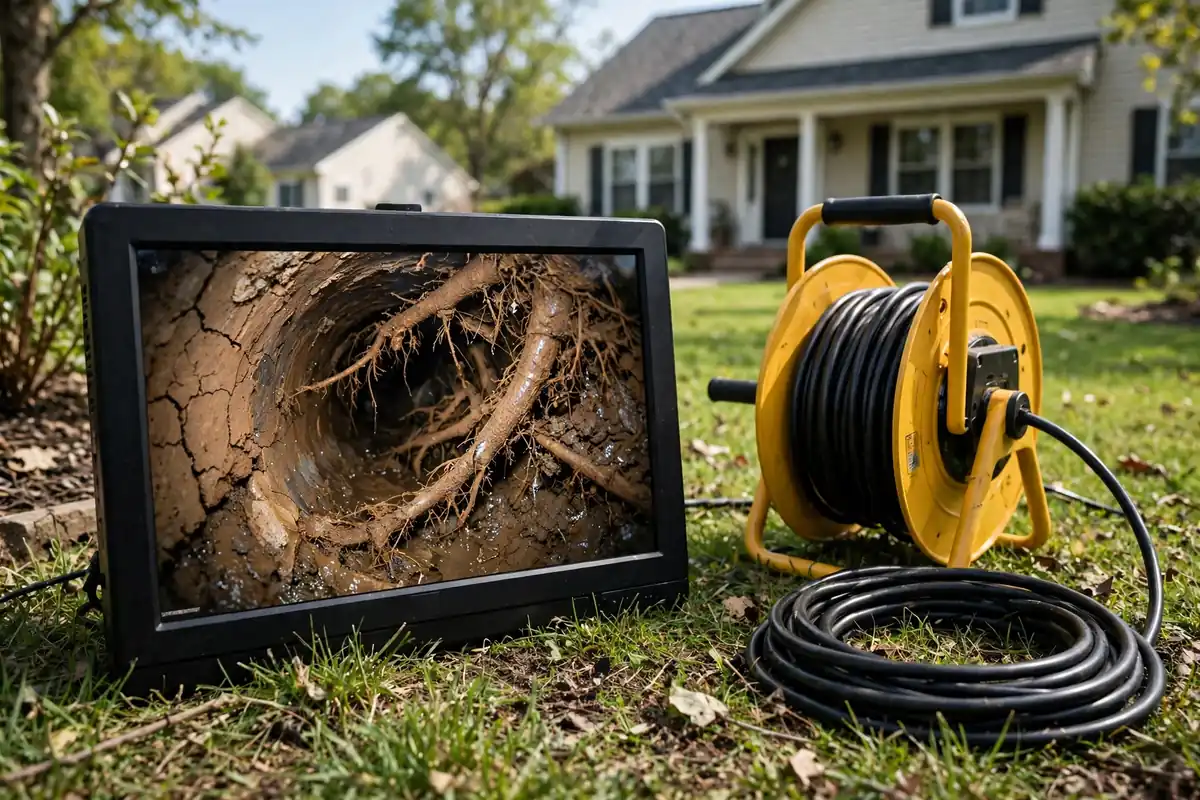
These are the signs that are most often dismissed as drainage quirks — a wet patch blamed on a low spot, a green strip blamed on a fertiliser spill, a smell blamed on a neighbour's bin. They are worth a look, because they are the earliest visible evidence of a lateral failure, and they appear months before the backup. A camera inspection follows the lateral from the house to the main and shows exactly what the yard is hinting at: the roots, the crack, the belly, and the distance of each from the access point.
The backup: what it means and what to do
A backup is the failure, not the warning. Sewage coming up through a basement floor drain, a ground-floor tub, or a shower means the main line is blocked or collapsed, and the water from anywhere in the house has nowhere to go. Stop using water in the house — including laundry and dishwashers — keep people and pets out of the affected room, and call. Do not pour chemical drain openers into a backed-up drain: they do not clear a main-line blockage, they damage older pipe, and they sit in the standing water. The clearing is the first step; the camera inspection that follows is what finds the cause, so the backup does not return.
A backup that happens in wet weather and stays clear in dry weather is a particular pattern: spring thaw and heavy rain raise the water table, and a lateral with a partial blockage that coped all winter backs up on the first heavy rain. The basement floor drain is the first place the water appears, because it is the lowest fixture in the house. A floor drain that backs up in wet weather is telling you the lateral is restricted, and the restriction is the repair waiting to happen.
What the camera shows — and what it decides
A sewer camera inspection is the step that turns the signs into a plan. A small waterproof camera is run through the lateral from a cleanout or a pulled toilet, and the operator watches the inside of the pipe in real time — every joint, every root, every crack, every belly — and records it. A transmitter in the camera head lets a locator mark the exact position and depth of each defect on the surface above, so any excavation starts at the right place. The recording is the evidence for whatever is recommended next, and it is worth asking to see it.
The camera decides between the repair options. A lateral with one broken joint and otherwise sound clay is a spot repair — digging up the whole line would be wasteful. A lateral with roots at every joint, a belly in the middle, and a collapsed section near the street is a replacement or a relining, because repairing one failure leaves two more in place. A sound pipe with heavy buildup is a cleaning job, and the money that would have gone to a repair stays in the homeowner's pocket. The sewer line repair page explains the options, and the trenchless sewer repair page explains the no-dig option. The camera is what prevents the wrong job as often as it confirms the right one.
The Harrisburg pattern: age, trees and the river
Harrisburg's lateral failures follow a pattern set by the city's housing and its trees. The median home was built in 1947, and the original clay or cast-iron lateral under a pre-1970 home has been in the ground for generations. Clay tile has joints every few feet, and each joint is an opening for a root seeking water — and the city's mature maples and oaks stand over those laterals, sending roots into every joint. Cast iron corrodes from the inside, narrowing until the flow drops and then failing at a weak section. The Susquehanna valley's freeze-thaw cycles move the ground a little every year, shifting joints and deepening bellies. In Shipoke, where the floodplain has taken river water in 1972, 2004 and 2011, laterals have been soaked and shifted more than once.
The homeowner owns the lateral from the house to the main — Capital Region Water owns the mains — so a lateral failure is the homeowner's repair, and the camera inspection is the homeowner's most useful step. A lateral that has never been camera-inspected is an unknown, and the first backup is usually the first time anyone has looked inside it. A pre-purchase camera inspection is the standard check for a home with an original lateral, and it is the only way to know the condition of a pipe that is eighty years old and buried under the front yard.
What to do now: the checklist
Walk the house and the yard with the signs in mind: several drains slow at once, gurgling across fixtures, a smell that returns after cleaning, a wet patch or a green strip in the yard, a floor drain that backs up in wet weather. If two or more of those signs are present, book a camera inspection. Clear access to the basement cleanout if you know where it is, keep a record of how often the line has been cleared and what was found, and ask for the recording and the written findings with distances from the access point. Keep the recording with the house records — the next owner will want it. And between visits, keep the prevention simple: nothing but toilet paper goes down the toilet, grease goes in a container in the bin, and a drain that starts slowing is a call before it becomes a backup.
Key takeaways
The signs arrive in order: slow drains across the house, gurgling, a smell that returns after cleaning, a wet patch or a green strip in the yard, and then the backup. Two or more of those signs together mean a camera inspection, not another clearing. The camera is the step that turns the signs into a plan — and the plan is chosen from the recording, not from the age of the house. The homeowner owns the lateral, so the inspection is the homeowner's most useful protection against a repair that arrives as an emergency.
Talk with a local plumbing professional
Hours: Mon–Fri 7:00 AM–10:00 PM ET · Sat 8:00 AM–10:00 PM ET · Sun 7:00 AM–9:00 PM ET
Call Now
Questions, answered
What is the first sign of a failing sewer line?
Several drains slowing at the same time, or gurgling across fixtures. One slow drain is a fixture problem; all of them together is a lateral problem.
What does a green strip in the lawn mean?
A leaking lateral feeds the soil above it, so the grass grows faster and greener in a straight line from the house toward the street. It is the earliest visible sign of a lateral leak, and it deserves a camera inspection.
Repair or cleaning — how is the call made?
From the camera record. A sound pipe with buildup needs cleaning. A pipe with a break, a collapse, a belly or roots at every joint needs repair. A line that clogs again soon after clearing has a structural cause, and the camera is what shows it.
Does the city fix my sewer lateral?
No. Capital Region Water owns the mains in the street. The lateral from the house to the main belongs to the homeowner, and so does its repair. The ownership line changes at the property line, which matters when a break is near the street.
Is a sewer inspection part of buying an older home?
It should be. A pre-purchase camera inspection is the only way to know the condition of an original clay or cast-iron lateral under a pre-1970 home, and the findings can shape the purchase decision — or confirm a sound line and remove the worry.
How does a camera inspection help before a repair?
It turns a recommendation into a plan. The recording shows whether the pipe needs cleaning, a spot repair, a relining, or a full replacement, and where the work should start. A repair recommended without one is a guess.
Questions about your plumbing? Call Now.
Talk with a local plumbing professional about your home. Hours: Mon–Fri 7:00 AM–10:00 PM ET · Sat 8:00 AM–10:00 PM ET · Sun 7:00 AM–9:00 PM ET.
Call NowGet in touch
Call Now from any page and you will be connected with a local plumbing professional serving Harrisburg and the surrounding metro. You can also reach us by email at hello@harrisburgplumbingpros.com.
Hours: Mon–Fri 7:00 AM–10:00 PM ET · Sat 8:00 AM–10:00 PM ET · Sun 7:00 AM–9:00 PM ET.
Call Now